How to Choose a Driving School – Presto Open Door Days

1. Introduction.
How to choose a driving school anywhere in Latvia — everything you need to know about driving schools and the driver-training industry as a whole. Transparently, shockingly and intriguingly, we expose every possible trick. We provide extensive information about all the criteria for choosing a driving school.
Welcome to Presto Driving School’s Open Days! With more than 20 years of experience and 8 years as one of the market leaders, we know how important the decision to choose a driving school is. This is more than the path to a driving licence: it is one of the first major purchases in life that should be made independently and thoughtfully.
Just 15 minutes of reading can save you months of training time and hundreds of euros. We will provide detailed, well-supported information that you may not have heard before.
We are here to help make your training experience predictable, financially transparent and positive. Below you will find a detailed list of topics to help you find the questions that matter to you immediately.
We will introduce the most important criteria for choosing a driving school.
2. Results.
Let us begin with the most important thing: results. What would be the point of a driving school if it did not deliver the result you need?
Results can be divided into three categories:
1. Driving licence.
Everyone wants a driving school that can take their training through to completion. Is that outcome transparent and predictable? If we consider the driving licence as the final result everyone understands, it only makes sense to assess it in the context of the time and money spent.
2. Time spent.
How long will it take to obtain a driving licence? Apart from your learning strategy, ability to focus and access to funds, the biggest influences are the driving school’s contract, business model and training system.
The theoretical minimum for category B is one month. Completing it within two months is most economical, while the average is six months.
Why do time limits matter? They are directly linked to costs: the longer you study, the higher the total cost.
Some driving schools charge an additional service fee if the six-month period is exceeded. Be careful and pay attention to such conditions, because the law allows one year to complete theory and three years to complete driving training.
3. Total costs.
The average cost of obtaining category B in Latvia is EUR 1,000. It is lower in the regions and much higher in large cities, where costs often reach EUR 1,500–2,000. This is a normal outcome, although it could be much better with the right system.
The same principles that affect the time spent will also affect your costs.
Conclusions.
Only by considering all three criteria together can you determine whether the final result was successful. Have you noticed a driving school talking about this?
3. Driving-school business models
Driving schools differ in their business models. Their main revenue comes from organising driving training. This is especially important for schools that do not consistently earn income from theory training because they continuously offer a free theory course.
There are only two business models:
1. Client-fee system. The instructor pays the driving school a commission for supplying a client. The school assigns you an instructor or creates the appearance of choice. The instructor pays the school EUR 40–240 to acquire a client. This way, each party secures its income from day one.
This business model exists in 98.5% of driving schools.
This amount automatically puts your training in the red at the start, without your knowing it. The instructor will try to recover the money by stretching out the training process. A student cannot notice that lessons are being artificially prolonged, because they do not know what proper training should look like. The problem is so complex that all the supervising state authorities (CSDD, PTAC and VID) are unable to find a solution.
How can you recognise this system?
- There is no electronic system.
- The contract encourages cash payments between the student and the instructor.
- There is no free choice. Changing instructors is administratively difficult.
- The school secures its profit from the first 10 lessons. After that, it is less interested in training quality.
- The instructor tries to build a relationship with the student so that, after 10 lessons, they can receive cash payment for lessons.
- Without competition, driving training is drawn out and the number of lessons increases substantially.
How can you protect yourself? NEVER leave your driving training to the discretion of one instructor. The only way to counter this system is to recognise it and choose the second option.
2. A digital system that lets you choose instructors freely and change them when necessary.
Look for a driving school with a digital instructor-selection system that creates healthy competition between instructors. Only competition for clients and the ability to vote with your money for service quality can provide fair training conditions and help you avoid excessive spending.
This business model is represented by Presto, Mustangs and Einšteins — 3 out of 200 schools, or 1.5%.
Benefits of being free to change instructors:
- Good instructors are readily available (you do not have to wait for one particular instructor).
- Intensive lessons help you finish sooner, because frequent driving lessons reinforce practice and reduce the total number of lessons needed.
- You do not become accustomed to only one instructor, improving your psychological readiness for the exam.
- Experience with different instructors and cars improves driving skills and broadens understanding and experience.
4. Learning material
The training programme is the real product you buy when choosing a driving school. Here we can talk about the learning material or content. Do you know anything about the programme under which you will be taught?
At present, no driving school in Latvia has its own school-wide programme for theory or practical training in any category.
Driving schools merely organise the training process, while licensed teachers provide training according to their individual programmes. They are not school employees but independent private business operators who often work with several driving schools at the same time.
This means your results depend directly on the teacher or instructor assigned to or chosen by you and on that person’s abilities.
Of course, the fundamentals of driver training are regulated by law. Yet each teacher and instructor approaches the material and methods individually. The materials gathered by specialists are meagre compared with the volume of content, poorly presented, often copied from one another and frequently infringe copyright.
The lack of coordination between these individual programmes and between theory and practice is one reason why the information given to students seems complicated and contradictory, making training long and expensive.
The first signs of systematic learning material appeared with the introduction of distance learning. This gives reason to hope that competition between driving schools for the best content will substantially improve driver-training quality. It is also why distance learning will be better than most in-person training and is currently the only indication that might reveal which school has the best learning material.
5. Theory training.
Distance learning or in-person classes?
Distance learning is cheaper than in-person training because it does not involve rising teacher and premises costs. Despite the higher price, some young clients choose in-person classes because their parents see this as a safe and familiar route. Everyone still remembers the average quality of training during COVID-19. Distance learning then meant a shared live online class, with many technical and attitudinal problems that interfered with individual learning.
The currently permitted form of distance learning is video training: a recording of a teacher with interactive elements. Only the road traffic rules section may be taught by video. For example, in category B that is 8 of the 11 lessons.
90% of clients choose distance learning. We have compiled the advantages and disadvantages of both forms of training.
| In person | +/− | Distance learning | +/− |
|---|---|---|---|
| You must wait for a group to start. As popularity has declined, waiting times have grown considerably; a group may be offered only in a Latvian regional centre. | − | Immediate access to individual training | + |
| More expensive theory course | − | Cheaper theory course | + |
| You spend time and money travelling to and from the school and must adapt to its timetable | − | Study at home at a time you choose | + |
| Learning pace is tied to the teacher and a particular group | − | Study at your own pace | + |
| You can ask questions and get answers immediately | + | You can ask questions immediately, but must wait for an electronic answer | − |
| The teacher delivers their own individual material | − | There is at least a small chance that the school has developed the material collaboratively | + |
| You can learn from other students’ questions and mistakes | + | You cannot learn from others’ mistakes (except for reviews of common errors on the platform or during consultations) | − |
Producers and developers of distance-learning products.
97% of driving schools currently offer video training. Note that only 5 of more than 200 schools produce video-training content: Presto, Einšteins, Credo Autoprieks, Mustangs and BAVA. The table shows where these distance-learning products are available and whether their makers also sell them to other driving schools.
| Driving school | Distance-learning platform | Sold to other driving schools | CSDD 2025 data |
|---|---|---|---|
| Presto | presto.lv | No | 1st place |
| Einšteins | edrive.lv | Yes | 2nd place |
| Credo Autoprieks | macam.lv | Yes | 3rd place |
| Mustangs | autoskolaonline.lv | Yes | 4th place |
| BAVA | bavaautoskola.lv | Yes | 5th place |

Pay attention to whose distance-learning product your prospective school uses. Their learning results differ greatly. Because the vast majority of driving schools use products developed by others, they cannot develop them or answer questions and provide advice about them. This in turn affects your results and associated costs.
6. Driving training.
Driving training accounts for 90% of expenses. No more than 10% of students with practical driving experience outside the school pass the school and state exams with the legal minimum of 10 lessons, or close to it. We therefore encourage you to read this section very carefully.
Types.
- 1. Before and alongside driving school — with parents or friends.
- 2. Within the driving school.
- 3. Individual training. This must not take place between an instructor and a driving-school client. It is usually useful for refreshing skills after driving school.
Programme.
No driving school has a unified driving-training programme. Training follows instructors’ individual programmes.
What should you know about choosing an instructor?
One of the most common student mistakes is assuming that a cheaper instructor will be as good as a more expensive one.
You can distinguish a good instructor from an ordinary one by these qualities:
- They are an excellent teacher who explains complex things simply.
- They communicate well and are easy and interesting to talk to.
- They are systematic and guide the student towards the result according to a plan.
- They are ethical and do not belittle other specialists’ work.
- They are patient and calm, without reproaches or shouting.
- They are tactful and respectful of your personal space.
An inexpensive, ordinary instructor will not meet your expectations on several of these points. A highly qualified specialist, however, will meet most of these criteria and prepare you in five or more fewer lessons than a cheap, ordinary instructor. Although lessons with a good instructor can cost more, the total cost will be lower because fewer lessons are needed.
Example.
| Number of lessons | Price per lesson, EUR | Total, EUR |
|---|---|---|
| 20 | 45 | 900 |
| 25 | 40 | 1000 |
The table clearly shows that the number of lessons is often more important than the price per lesson.
Important! In calculating the total cost of driving lessons, a new car (even one matching the CSDD exam car) is the least important factor, while market principles matter most.
What do you know about a driving school’s instructors? Look at its social media: read reviews, watch videos showing instructors and their teaching style, and notice what the school says about itself and how. Social-media content helps you understand its attitude, communication style and approach to training.
If you find driving difficult, are not technically minded and need more lessons than in the example, a good instructor will have an even greater financial impact on the final cost.
Changing instructors. Should you change instructors?
In many Latvian regions, the choice of instructors is limited. Most driving schools do not provide for changing specialists or working as a team. Only a school where teachers and instructors work within a strictly regulated system can guarantee quality.
We can recognise quality only through comparison:
Only then can you discover which instructors suit you best.
If an instructor knows there will be no competition, training will automatically take longer and cost more.
Payments.
We particularly want to draw attention to the fact that, under Cabinet Regulation No. 358, paragraphs 36 and 36 prim, all payments for driving training must go through the driving school.
Important! If you have a valid contract with a driving school, the concept of individual training does not apply. Both cash payments and bank transfers against a receipt are unlawful. An instructor’s claim that the school contract ends after the minimum 10 driving lessons and that individual training then begins is legal nonsense.
Why is this dangerous? If you choose to pay this way, you lose all legal and contractual protection. If problems arise with training quality, you will not be able to defend your rights with either the driving school or CSDD.
Such individual lessons are usually not registered with CSDD and taxes are not paid. Unregistered lessons may prevent you from applying for either the school or the CSDD exam. According to internal CSDD information, at least 50% of lessons are unregistered, distorting the overall statistics needed to calculate the actual volume of training nationally. Incorrect training volumes lead to unprepared road users and serious road traffic accidents.
The instructor acts dishonestly towards the client, the school and CSDD, and may face legal consequences. Report such cases to your school, CSDD and VID to protect yourself and others. Your rights matter, and official payments are the best way to ensure training quality by keeping the instructor within a supervised system.
7. Statistics.
CSDD exam statistics — passing on the first attempt — and statistics on driving-school graduates play an important role when choosing a school.
CSDD publishes detailed statistics on driving schools, teachers and instructors passing state exams on the first attempt. You can find this information by searching Google for “autovadītāju apmācība”; the search leads to this link: csdd.lv/autovaditaju-apmaciba.
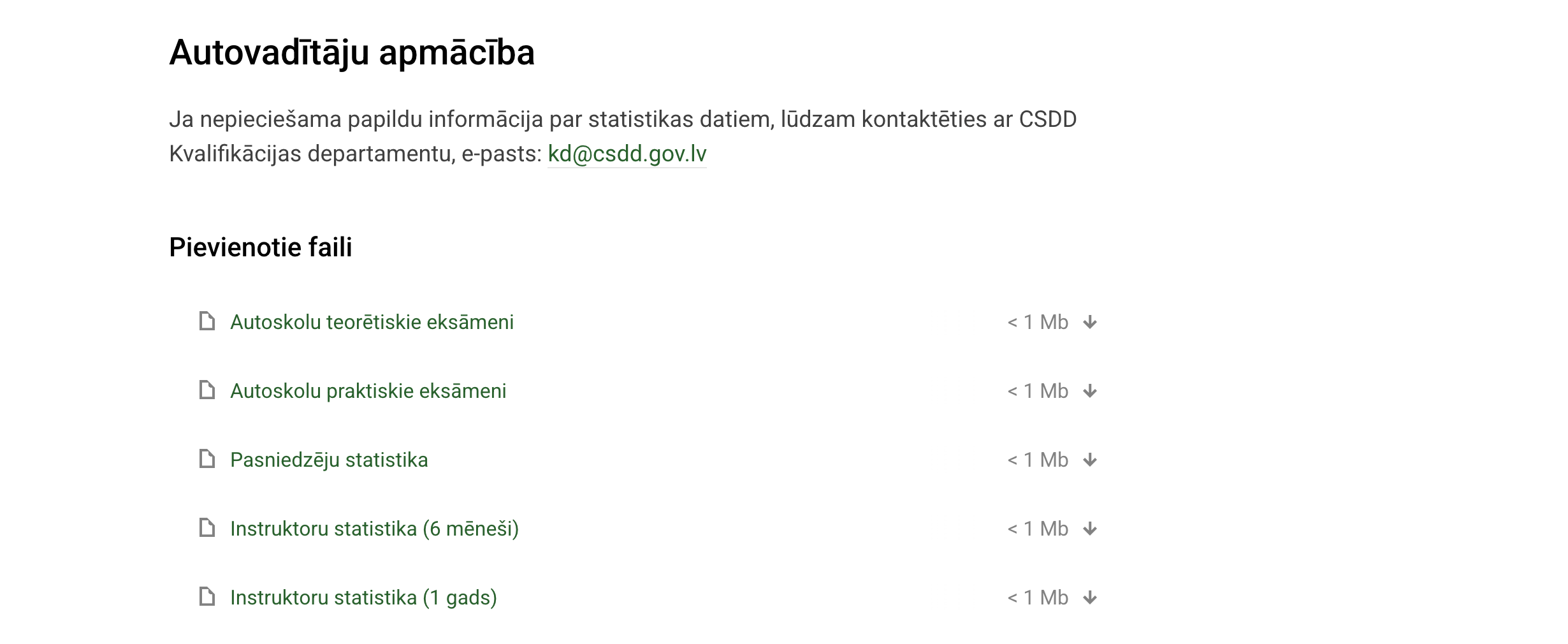
Theory statistics currently combine results for in-person and distance learning, but CSDD plans to show the results of distance-learning platforms (electronic environments) separately. CSDD also provides those results on request.
CSDD driving statistics are not straightforward, because the difficulty of driving exams differs severalfold between Riga and the regions. A school with a large proportion of Riga students may therefore have an average result.
In March 2026, CSDD presented driving-school graduate data for the first time: what happens to people in the first two years after graduation, including road accidents, injuries, deaths and offences. Driving-school portals display this data. For statistics to be meaningful, only large datasets (student numbers) reveal the lasting value of training quality.
Would it not make sense to choose a driving school with strong statistical results and reduce the money spent on state exams?
8. Marketing.
Driving-school marketing aims to attract attention and encourage people to sign a contract. On social media, schools now often compete to create entertaining and humorous content. Yet driver training is also a matter of social responsibility, because the number of road accidents in Latvia remains high.
Driving-school advertising most often relies on reducing the price of the theory course, and less often on discounts for registration or driving lessons.
Popular advertising slogans include:
- “Free theory”
- “Spin the wheel of fortune”
- “Theory for only EUR 1”
- “The price depends on the day”
- “Name your price”
Can a driving school really offer almost two weeks of work entirely free? It can, but such “savings” are usually offset by other services, most often driving training.
A discount often prompts an emotional rather than rational decision. Games, prize draws and large discounts distract from the essentials: total study time, final costs and training quality.
A school may recover this discount by increasing the price of other services — document processing, first-aid courses, a medical certificate or driving training. Many separate prices make it harder for a customer to understand the true final cost.
Our observations over the past 10 years show that some schools offer discounts almost every day. If a “promotional price” applies almost continuously, ask yourself whether it is really a discount or simply a different pricing structure for the services.
Consequences
A “discount” usually amounts to only 1–3% of total training costs, so apparently large initial savings may prove insignificant in the end. Our experience shows that a free-theory promotion can cost a client at least ten times the initial saving: for example, saving EUR 25 may turn into more than EUR 250 in extra costs, usually in driving training.
As for training quality, the reality is that such schools systematically teach students less well because they want you to overlook theory quality and learn theory during driving lessons. Why? Because a single driving lesson costs as much as the entire theory course. Such schools also rush practical training through deadlines and penalties.
Because data on the actual time and money spent on training are not public, this practice is carefully concealed. You cannot know what you have not experienced. You cannot understand something when you do not know what it should look like. People who realise they have fallen into a trap usually do not want to discuss their negative experience. Industry specialists, however, understand what is happening and have compiled this information specially.
Word-of-mouth recommendations for driving schools.
People often choose a school on the recommendation of a friend, relative or another trusted person, especially after that person has had a positive experience with a particular instructor. But is one recommendation enough? The short answer is no.
One person’s positive experience does not guarantee that yours will be the same. The instructor may have changed schools, work in another system or simply not suit your character and learning style. Training takes time, and cooperation between two people is always individual.
Remember that an instructor’s work is not separate from the rest of the school. Practical training should be assessed alongside theory quality, administration, contract terms and the technology used.
A personal recommendation can therefore be a good starting point, but it should not be the only criterion for choosing a driving school.
9. Contract.
Our experience shows that about 90% of clients do not pay enough attention to their contractual relationship with a driving school. This can lead to disputes, wasted time and additional financial consequences.
The contract usually covers the entire training process and associated costs, so it can also serve as a checklist during training. Pay particular attention to study deadlines, additional payments, termination terms and the responsibilities of both parties.
Discounts advertised by schools often come with unfavourable contract terms. Check for excessively short deadlines, such as 3–6 months to complete theory even though the regulations allow up to 12 months, or pressure to start driving before theory is complete. This can be especially disadvantageous for school and university students, who may have to start the process again if the deadline is too short.
Assess whether the contract is balanced: do obligations and responsibilities apply to the school as well as the student? Is there a clear complaints procedure? Does the school accept responsibility for poor or incomplete service?
Read the contract before signing it. You have the right to request it in advance. Our observations show that only a few of roughly 200 driving schools allow people to read their contract freely before enrolling, so this can be an important criterion when choosing a school.
10. Using artificial intelligence to choose a driving school.
There is no point asking artificial intelligence, “Which is the best driving school?” It is better to compare schools against specific criteria:
- 1. Location — compare schools in the city or region where you plan to study and take exams. Driving-test results from different cities cannot be compared directly because exam difficulty varies substantially.
- 2. Contract terms and risks — check for unreasonably short deadlines, extra payments or conditions that could make training more expensive.
- 3. Total time and costs — how much the journey to a driving licence will cost and how long it will take.
- 4. Training quality and exam results — consider CSDD theory and driving-test statistics in the context of a particular city or a comparable examination environment.
- 5. Results after driving school — CSDD graduate statistics help show how well the acquired skills serve drivers in real traffic.
Example prompt: “Compare driving schools for category B training in Riga by contract risks, total costs and time, CSDD theory and driving-test results, and graduate statistics.”
11. Learning strategy
Getting started
Choose the right time to start training, when you have enough motivation to invest time, attention and money in achieving your goal. Training is most likely to be completed when a driving licence is truly needed, for example for daily needs, family or new work opportunities.
Starting only because of a promotion or discount is usually an emotional rather than practical decision.
Time
Sprint — it is most economical to prioritise this training above other activities and complete it as quickly as possible, preferably within 2–3 months.
Money
Before starting, it is essential to consider whether you will have a sufficient, continuous budget for the entire training process. Interruptions in driving training due to lack of funds extend the time needed, weaken retention of skills and may increase the total cost.
Choosing the right type of car for training
Learning in a manual-transmission car gives you more versatile skills and lets you drive both manual and automatic cars. An automatic is also a modern, fully valid choice: an increasing proportion of new cars are made with automatic transmissions.
An automatic can be particularly suitable for people who initially find it hard to control many things at once: traffic, signs, mirrors, steering, clutch and gears. A lower technical workload lets them focus more on traffic and safe driving.
For some students, this also means learning skills sooner and needing fewer driving lessons, which lowers the total training cost.
Fast or safe?
An individual learning strategy matters here. It is possible to pass the school and CSDD exams without fully consolidated knowledge and skills, but that does not mean a person is completely ready to drive independently in everyday traffic.
Sound self-assessment matters: an honest judgement of whether your skills are sufficient not only for the exam but also for safe daily driving. CSDD graduate statistics also help show what happens to new drivers after they finish driving school.
How to minimise total costs
Considering both time and total cost, it is most economical to finish the theory course before starting driving training in traffic. The sooner theory is learned, the easier it is to reinforce fresh knowledge in practice and avoid having to study theory alongside driving.
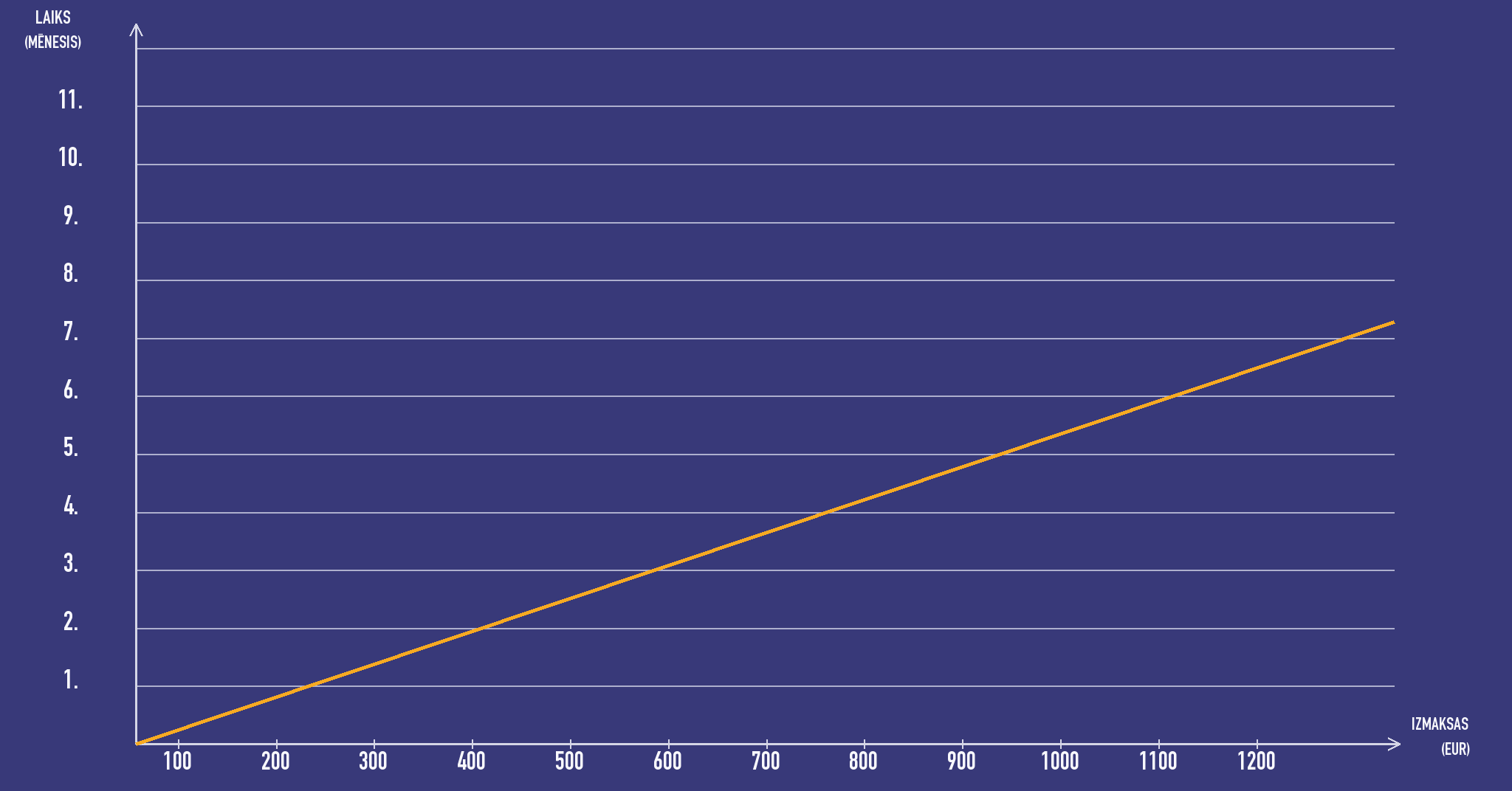
If time is limited, driving training in traffic can begin after the fifth theory lesson. Until then, it is advisable to learn the car’s basic technical, ergonomic and control functions with an instructor on a practice ground.
12. Presto Driving School.
Although this story is about you and choosing a driving school thoughtfully, we also want to show how Presto Driving School meets the criteria discussed above.
Our motto is “University of Drivers”. It describes Presto’s approach: systematic, structured and results-oriented training. The school has developed its own organisational, structural and teaching systems to provide a consistent, predictable learning process.
For several years, Presto has been among Latvia’s largest driving schools and statistical leaders. The results speak for themselves: Presto ranks first in CSDD theory-exam statistics and first for electronic learning platforms among more than 200 schools.
What happens after obtaining a licence matters too. CSDD graduate statistics show that, among Latvia’s largest driving schools, Presto graduates have the fewest road accidents and injuries, no fatalities and the fewest offences.
The aim is therefore not only to prepare a student for an exam. More important is teaching them to think, act with discipline and drive safely and independently in daily life.
Leader in innovation
Presto has introduced most of the training technologies used in Latvia, offering modern methods that make training more effective.
Presto was the first driving school in Latvia to introduce an electronic driving-lesson organisation system, in 2016.
Team
Our excellent team of teachers and instructors is one of Presto’s greatest assets. Teacher trainer Ēriks Griģis and instructor trainer Rūdolfs Jākabsons are pioneers in their fields, trusted by specialists throughout Latvia.
They lead the development of programmes and systems that guide specialists’ work at the school. The team brings together carefully selected experienced and new specialists who can jointly provide the best possible results. The website includes reviews from real students for every instructor and teacher, and many specialists actively contribute to the school’s content on the most popular platforms. This helps you get to know and choose the right specialist.
Programme
Presto offers a world-class training programme available only at the school. Our programme director Ēriks Griģis is the only specialist of this level in Latvia who has combined experience from the most advanced European countries and adapted it to Latvian conditions.
The methodological examples and exam tips included in training help students find the right answers in both theory and driving exams.
Our programmes and technologies aim to make training more transparent and reduce student costs.
Distance learning
Presto is the only distance-learning product developer that does not sell its product to other driving schools. It is therefore exclusive, and its results can be obtained only here.
A large team of specialists created it, and its quality far exceeds the individual programmes of any Latvian specialist, including in-person programmes.
Presto is the only driving school in Latvia to offer extensive consultations for its video-training product. Our students can get help online and by phone, making remote learning convenient for everyone.
Social responsibility
Presto is a socially responsible driving school that never offers discounts at the expense of your costs and safety. Instead, you receive convincingly the best learning content in Latvia and a system for mastering it.
Costs
This table reflects the current market price level and helps you compare all major cost items, not just one promotional price.
| Item | Market prices | Presto Driving School | Driving School X |
|---|---|---|---|
| Document processing | 20 | EUR 20 — remotely EUR 30 — in person in Riga |
? |
| Theory course | Distance learning — EUR 40 In person — EUR 65 |
Distance learning — EUR 20 In person — EUR 60 |
? |
| First-aid course | EUR 55 | EUR 55 | ? |
| Medical certificate | EUR 40–45 | EUR 28.50 — Ventspils EUR 38 — Riga |
? |
| Driving lesson | Depends on region | Market price minus EUR 1–2 | ? |
We encourage you to compare Presto’s total costs with other driving schools rather than only one price shown in an advertisement.
Presto offers free financing for six months so that driving training need not stop for lack of money. This makes it possible to study more intensively — for example, to finish driving training in about two months — and reduces the risk of needing extra lessons after a break.
Presto is one of the few driving schools registered as an educational institution. In certain cases, students or their parents can therefore declare study expenses and receive a personal income tax refund of up to EUR 612 a year if the licence is needed for a profession or work duties.
Presto also offers a referral programme through which you can be rewarded for recommending the school to friends and acquaintances.
Using all available options — lower prices for individual services, financing, an income-tax refund and the referral programme — can reduce total training costs by several hundred euros, with savings of EUR 300–1,000 in some cases.
Contract
Presto was the first driving school in Latvia to let prospective students read its contract remotely before enrolling and remains one of the few that do so. We encourage you to read it.
- Training periods comply with the periods set by law.
- There is a clear complaints procedure: administration → management.
- We are the only driving school in Latvia that accepts financial responsibility for service quality.
Simply follow these steps to sign a contract quickly and easily:
- Visit our website: presto.lv
- Choose the category you need.
If you wish, our administrator can prepare the contract for you for EUR 10. (Note: the document registration fee when signing in person totals EUR 30.00; remotely it is EUR 20.)
13. Information for parents
Parents who often help their children obtain a driving licence should understand that substantial changes have taken place in driving schools and the CSDD exam system over the past 20 years. Understanding these processes helps avoid unrealistic expectations and support a child better during training.
1. Learning theory and taking exams
It is no longer possible to pass a school or state theory exam merely by memorising pictures. Since 1 June 2024, CSDD exam questions and driving-school tests have no longer matched: their content and approach differ significantly. Passing the theory exam has become several times harder.
2. Number of driving lessons
The legal minimum number of driving lessons has increased substantially. In 2016 it rose from 7 to 10, and a minimum of 15 lessons is planned for 2026. Traffic intensity and the numbers of vehicles and road signs are rising, so learning the necessary skills takes longer.
3. Systematic monitoring of training
It is no longer possible to “arrange” simulated progress — that is, to pay for credit for lessons that never happened. Corruption in the state exam system is also a thing of the past: the last known cases date back more than 10 years.
CSDD systematically supervises theory and practical training.
4. Costs and their structure
The total cost of obtaining a driving licence has increased three- to fivefold. Every driving-school service, especially driving lessons, has become more expensive, mainly due to inflation.
A separate contract fee is now distinguished from the theory-course price. Schools variously call it a document-processing, student-registration or service fee (for category B, covering up to three years). It reflects the school’s real customer-service costs.
5. Driving-school practical exam
The driving-school practical exam has returned, with interruptions, as a compulsory part of training. This arose from the need to prevent poorly prepared candidates from applying en masse for CSDD exams, followed by complaints, analysis of video recordings and legal proceedings. The underlying problems were:
- training budgets that were too small;
- insufficient understanding of the requirements;
- dishonest instructors — inaccurate assessment of skills and misleading information about CSDD requirements.
6. Digital changes
Various digital solutions have appeared in the industry since 2016, but only about 2% of schools currently use them. Digital tools greatly improve convenience: they allow remote contract signing, electronic records and driving-lesson systems, and online payments.
7. Payment procedure
In the past, paying instructors in cash was common. Since 2016, CSDD has clearly established that the driving school supervises the entire training process. Payment can therefore legally be made only through the school. Read more in section 6 of this article.
8. Market changes
The market is steadily consolidating: large schools grow larger, while small ones lose volume and often disappear. Small driving schools cannot ensure the same level of training quality and service.
9. Distance learning
Since 2022, theory learning by video (distance learning) has been officially permitted. Only the largest Latvian driving schools have developed their own distance-learning products, whose quality and content differ substantially. Read more in section 5 of this article.
10. Driving-lesson deposit
Many schools have introduced a driving-lesson deposit: an advance payment for lessons. Initially used by only some schools, it has now become standard practice to confirm the student’s commitment to investing in their goal. Deposit amounts can differ two- or threefold between schools, so they deserve attention.
14. Questions?
If you have further questions after the presentation, we recommend first visiting the frequently asked questions (FAQ) section on the page for your chosen category.
If you cannot find the answer there, please call or write. You can also leave your questions in the comments below this article, and our administration will reply within two working days.