Automatic transmission in driving school: should you take category B with an automatic?
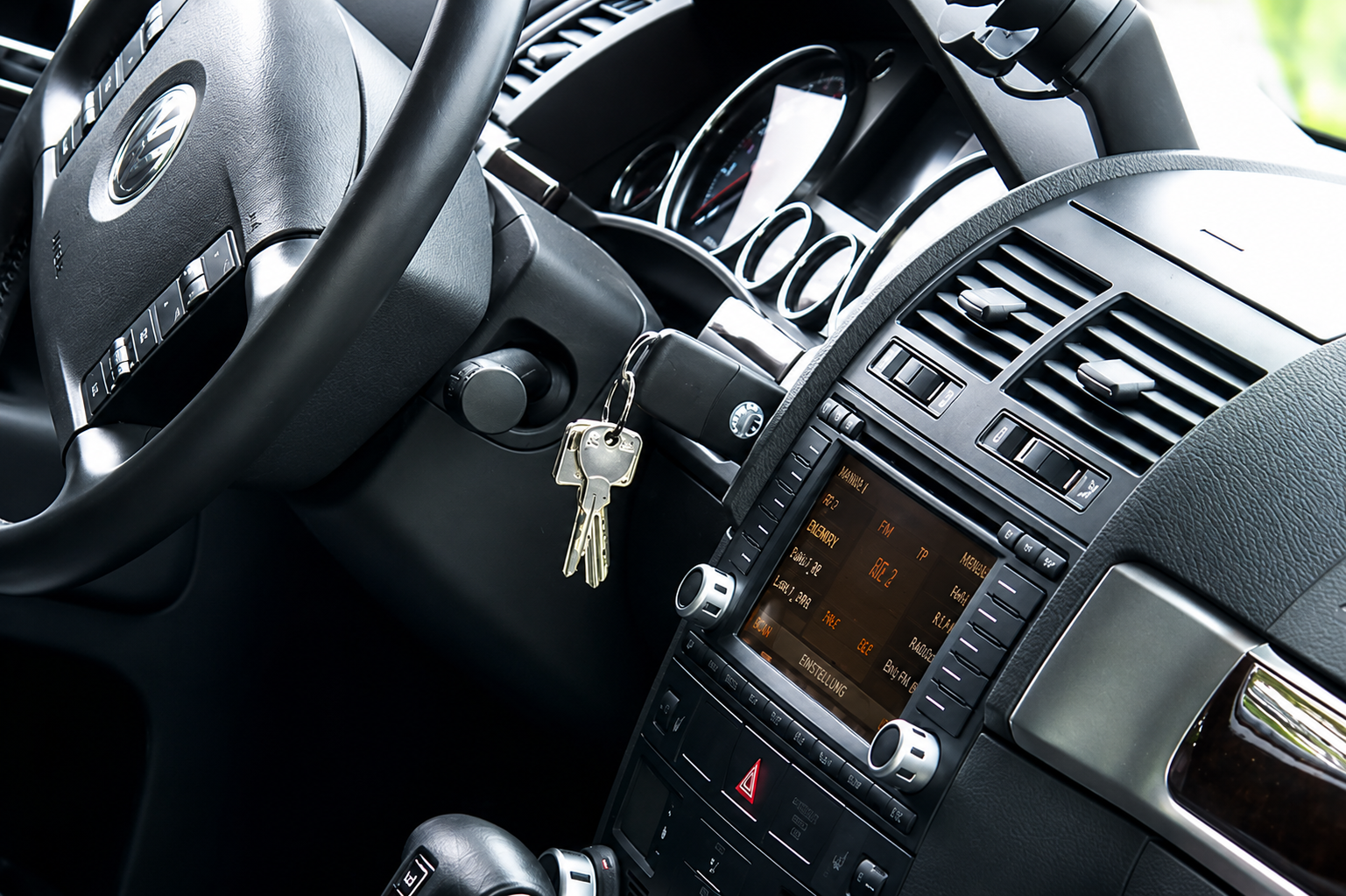
Automatic transmission is no longer a luxury or a choice for “lazy drivers”. It has become an everyday standard in city traffic, car-sharing vehicles, hybrid cars, electric cars and an increasing share of new cars. Therefore, the question is no longer just “are automatic-only driving rights real driving rights?”, but a much more practical one: is it more beneficial for a specific person to take category B training and examination with an automatic or manual gearbox?
The answer is not the same for everyone. An automatic transmission can be a rational choice if the aim is to learn to participate safely in road traffic faster and with less stress. A manual gearbox, however, remains valuable for those who want universal driving rights without restrictions and the ability to drive any category B car.
What is an automatic transmission?
An automatic transmission, or automatic gearbox, is a system that selects and changes gears itself while driving. The driver does not need to press the clutch pedal and does not need to change gears by hand as in a car with a manual gearbox.
A car with an automatic transmission usually has only two pedals:
- the brake pedal;
- the accelerator pedal.
The driver selects a driving mode, for example D for driving forwards, R for reverse, P for park mode, and then focuses on traffic, road signs, speed, distance, trajectory and making safe decisions.
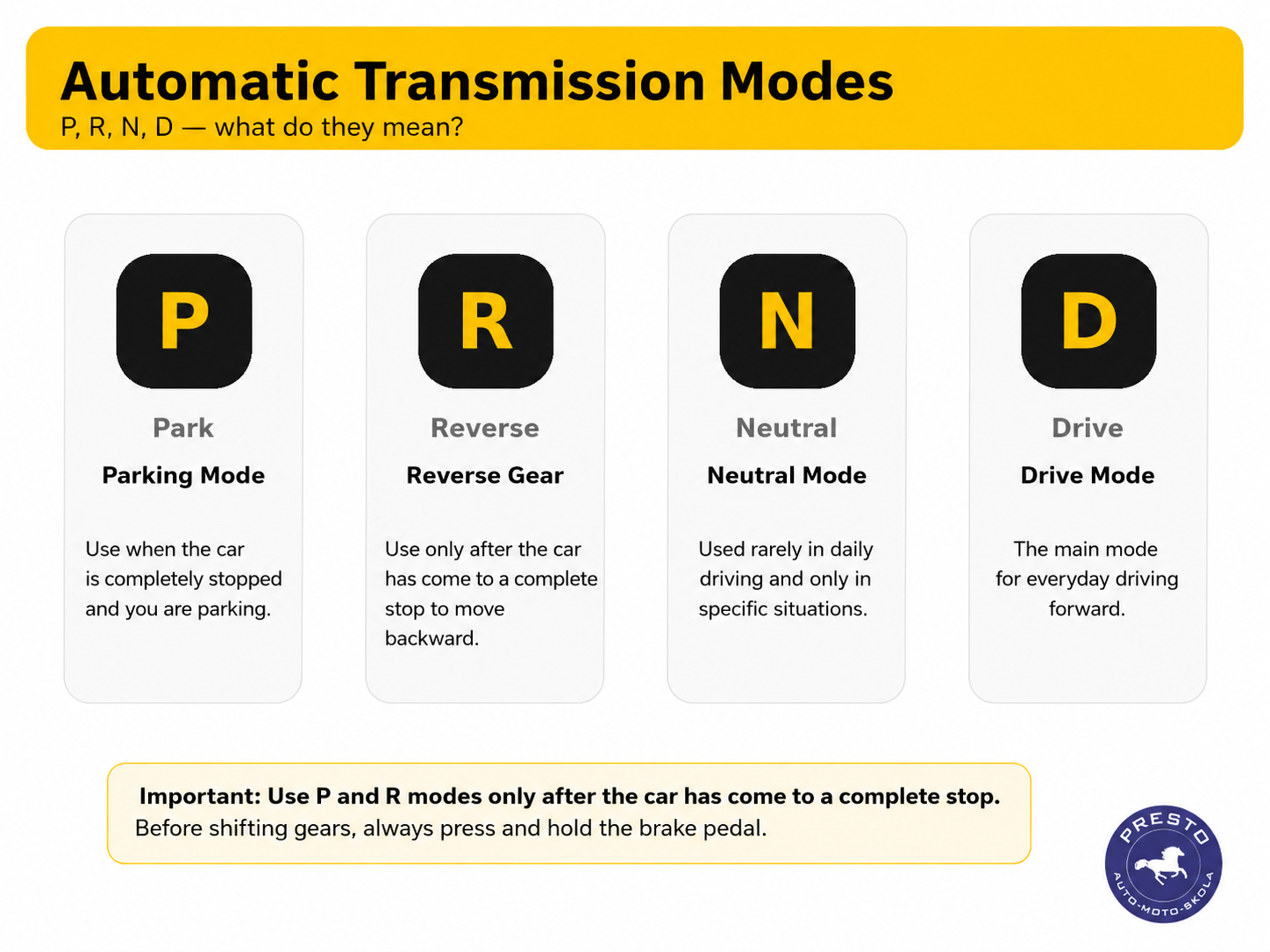
What do P, R, N and D mean in an automatic transmission?
Automatic transmissions may have different modes, but the basic symbols are mostly similar:
P jeb Park – parking mode. It is used when the car is parked.
R jeb Reverse – reverse gear.
N jeb Neutral – neutral mode. In everyday driving it is used rarely and only in specific situations.
D jeb Drive – driving forwards. This is the main mode for everyday driving.
Some cars also have additional modes, for example S for sport mode, B mode in electric or hybrid cars, or the option of manual shifting with a lever or paddles behind the steering wheel. In driving school, the most important thing is not to learn every technical mode, but to learn safe and correct vehicle control in real traffic.
Can you learn to drive with an automatic transmission in driving school?
Yes, category B driving training can be completed in a car equipped with an automatic gearbox. This means that the student can learn to drive an automatic car and also take the CSDD driving examination in a car with an automatic gearbox.
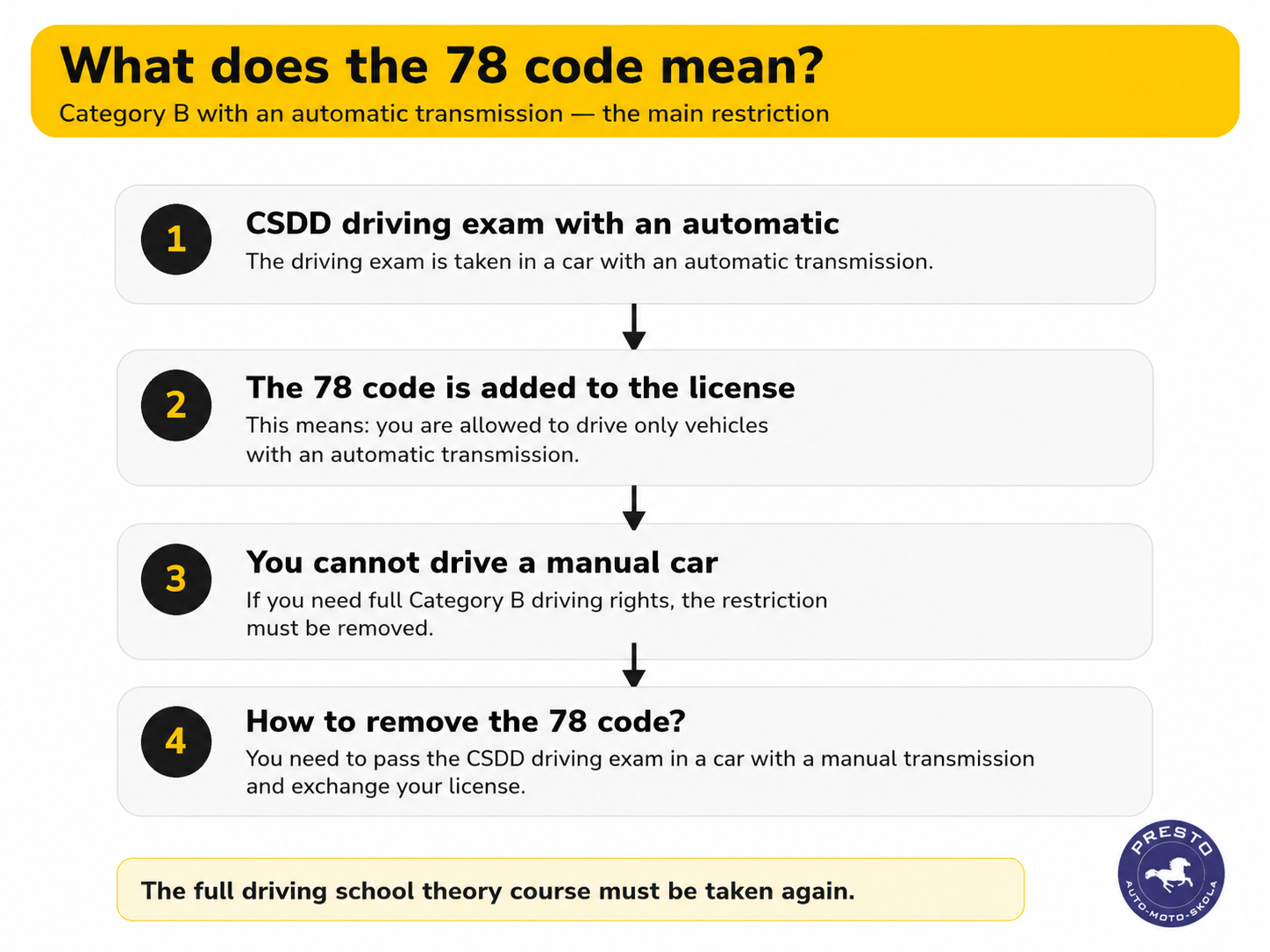
In this case, after passing the examination, restriction code 78 is entered in the driving licence. This means that the driver may drive only vehicles with an automatic gearbox.
What is code 78 in a driving licence?
- The code means that the category B driving licence was obtained by taking the driving examination in a car equipped with an automatic gearbox. This code restricts the driving rights: with such a licence, the driver may drive only a car with an automatic gearbox.
In practice, this means:
- with B(78) driving rights, you may drive cars with automatic transmission;
- you may not drive a car with a manual gearbox;
- if full category B driving rights without code 78 are needed later, the CSDD driving examination must be taken with a manual gearbox;
- there is no need to attend the driving school theory course again.
Is the CSDD examination with an automatic car easier?
The CSDD requirements for the category B and B(78) driving examinations are essentially the same. The examination assesses not how difficult it is to change gears, but whether the driver can participate in road traffic safely and independently.
The following are assessed:
- the ability to comply with the Road Traffic Regulations;
- the ability to join the overall flow of vehicles;
- situational awareness and decision-making;
- maintaining distance and lateral clearance;
- intersections, lane changes, overtaking and turning manoeuvres;
- the ability to drive safely, predictably and confidently.
However, students often subjectively find automatic transmission easier because they do not need to think about the clutch, gear selection, stalling, starting on a hill and changing gears in traffic jams. As a result, more attention can be devoted to what truly determines safe driving – observing traffic, following the rules and making correct decisions.
Automatic or manual gearbox – which should you choose?
The choice between an automatic and manual gearbox significantly affects both the training process and future driving experience. Therefore, the decision should not be made only on the advice of parents, friends or internet comments. You should assess your goal, budget, stress level, planned car and real needs.
When is it better to choose an automatic transmission?
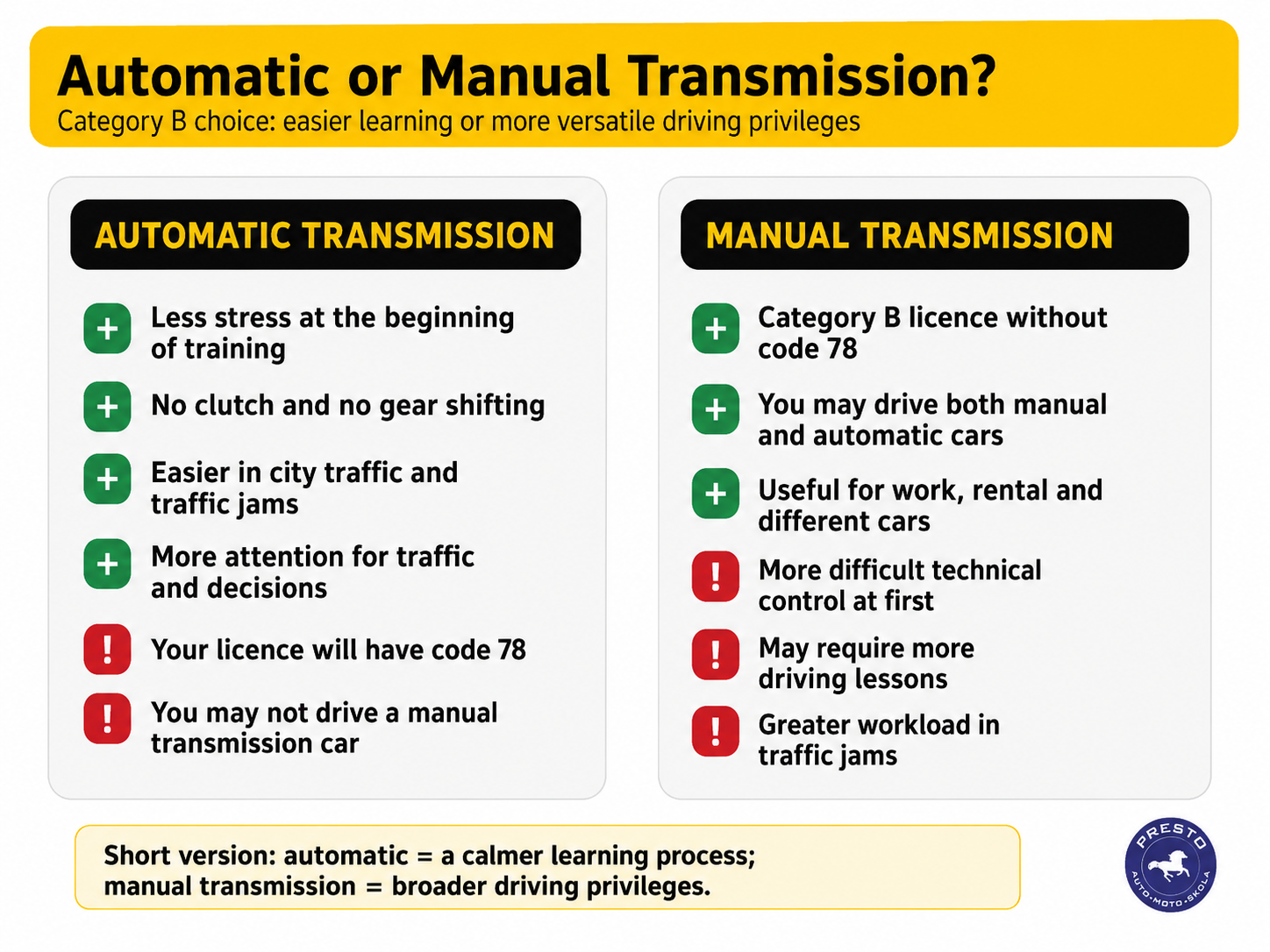
An automatic transmission is especially suitable if:
- you want to learn with less stress;
- it is important for you to obtain a driving licence faster;
- you plan to drive in the city every day;
- your family already has a car with an automatic gearbox;
- you plan to drive a hybrid or electric car in the future;
- you do not want to focus on the clutch and gears at the beginning of training;
- you have movement limitations or difficulties coordinating several actions at the same time;
- your priority is safe, calm and predictable mobility, rather than the universal ability to drive any car.
When is it better to choose a manual gearbox?
A manual gearbox may be the better choice if:
- you want category B driving rights without code 78;
- you want to be able to drive both automatic and manual cars;
- you plan to rent cars in countries or places where manual cars are still common;
- you may need to drive different cars at work or in your family;
- you want a fuller understanding of the technical control of a car;
- you enjoy more active involvement in driving.
Advantages of automatic transmission in driving school
1. Less stress at the beginning of training
For many students, the most difficult thing at the beginning of training is not the Road Traffic Regulations, but coordinating several actions at once: clutch, accelerator, brake, gears, mirrors, road signs, pedestrians, traffic lights, lanes and other vehicles. Automatic transmission reduces this load.
The student can focus sooner on understanding traffic and the logic of safe driving rather than on fear of stalling at an intersection or starting on a hill.
2. Easier driving in the city
In the city, you often need to stop, start moving, drive slowly, monitor pedestrians, cyclists, public transport and the actions of other drivers. In this environment, automatic transmission is very convenient because there is no need to change gears constantly.
This is especially noticeable in Riga and other larger cities, where traffic jams, dense traffic and frequent stops are part of everyday life.
3. Potentially fewer driving lessons
For some students, automatic transmission allows faster progress in the training process because the technical control of the car requires less attention. This does not mean that everyone will need the same number of lessons, but an automatic car often helps students reach the main goal faster – safe driving in traffic.
If the student does not need to struggle with clutch operation, stalling and gear changes, more time can be used for intersections, lane changes, route planning, hazard anticipation and examination situations.
4. Less fatigue in everyday driving
An automatic gearbox reduces physical and mental load, especially in traffic jams. On a longer journey or after a working day, this can be an important factor for comfort and safety because the driver becomes less tired from mechanical actions.
5. It matches the direction of the future car market
New cars, hybrid cars, electric cars, premium cars and car-sharing vehicles are increasingly equipped with automatic gearboxes or systems where the driver does not need to change gears manually. Therefore, automatic transmission is not an exception but increasingly an everyday standard.
Disadvantages of automatic transmission
1. Restriction code 78
The biggest practical disadvantage is code 78 in the driving licence. If the examination was taken with an automatic gearbox, such a licence does not allow driving a car with a manual gearbox.
This may matter if in the future:
- you will need to drive different cars at work;
- your family will have a car with a manual gearbox;
- you plan to rent a car where mainly manual models are available;
- you want complete freedom to choose any category B car.
2. A limited sense of universality
A driver trained with a manual gearbox may drive both manual and automatic cars. A B(78) driver, however, is initially allowed to drive only automatic cars. This does not mean that the choice is bad, but the restriction must be understood before taking the examination.
3. Manual gearboxes are still common in the older car market
Although automatic gearboxes are becoming increasingly popular in the newer car segment, manual gearboxes are still common in the older and cheaper used car market. If you plan to buy a cheaper used car, this factor should be taken into account.
Use and ownership: which gearbox is more convenient and cost-effective in everyday life?
When choosing between an automatic and manual gearbox, it is important to think not only about driving school and the CSDD examination, but also about what car you will drive after obtaining your licence. Everyday convenience, the car’s purchase price, maintenance costs, rental options and future car market trends can be just as important as the training process itself.
Convenience in everyday driving
In everyday use, automatic transmission is usually more convenient. This is especially noticeable in the city, in traffic jams, in car parks, at traffic lights and in slow-moving situations. The driver does not need to keep pressing the clutch and changing gears, so driving is calmer and less tiring.
A manual gearbox requires more active involvement from the driver. Some people like this because the driver has more control over the car and can choose the gear more precisely. However, in intensive city traffic, a manual gearbox can be more tiring, especially for beginners.
Fuel consumption and economy
In the past, a manual gearbox was often considered the more economical choice because older automatic gearboxes consumed more fuel. Today, this difference is no longer so simple. In newer cars, automatic gearboxes have become more efficient, while in the hybrid and electric car segment automatic drive control has become an everyday standard.
However, the situation in the used car market can still differ. For older, simpler and popular models with a manual gearbox, use and maintenance can be cheaper because repairs are often simpler and spare parts more available. For newer cars, however, the specific model, engine, gearbox type, mileage and service history must be assessed.
Maintenance and repair costs
A manual gearbox is usually simpler in construction. Its repair can often be cheaper, especially in older cars. However, a manual gearbox also has wear parts, such as the clutch. If the driver often drives in the city or uses the clutch incorrectly, clutch repair or replacement can become a significant cost.
An automatic gearbox is technically more complex, so its repair in the event of a fault can be more expensive. Used cars with high mileage and unclear service history should be assessed especially carefully. Proper maintenance, oil changes and following the manufacturer’s instructions are important for an automatic gearbox.
This does not mean that an automatic gearbox is disadvantageous. A well-maintained automatic gearbox can last a long time and provide very comfortable driving. The main thing is not to buy a car only on the basis of “automatic” or “manual”, but to check the technical condition of the specific car.
Car rental and universality
A manual gearbox provides greater universality because a driver with a full category B licence can drive both manual and automatic cars. This may be important if you plan to rent a car, drive a work car or use different family cars.
With B(78) driving rights obtained after an examination with an automatic gearbox, you may drive only cars with automatic transmission. CSDD states that the B(78) examination requirements are the same as for the category B examination, but code 78 is entered in the licence, restricting driving to automatic gearboxes only.
Therefore, if you may need to drive different cars in the future, a manual gearbox provides broader options. If you will drive only an automatic car in everyday life, code 78 may not be a practical problem.
Car market trends
Automatic gearboxes are becoming increasingly common in the newer car market. This is driven by the popularity of hybrid cars, electric cars, premium cars and car-sharing vehicles. European Union climate policy is also directing the new car market towards lower-emission vehicles; the current regulatory direction provides that from 2035, new passenger cars placed on the market will have to have zero CO₂ emissions.
This does not mean that the manual gearbox will disappear immediately, especially in the used car market. However, in the long term, automatic transmission and automatic drive control are becoming an increasingly familiar choice.
Sporty driving and the feeling of control
A manual gearbox is still preferred by some sportier drivers because it allows the driver to control gears and vehicle dynamics more actively. For some people, this is an important element of driving enjoyment.
At the same time, automatic gearboxes have also developed significantly. Many cars have a sport mode and the option of manual shifting with a lever or paddles behind the steering wheel. Therefore, a modern automatic no longer means passive or slow driving.
Towing and moving the car in the event of a fault
With a manual gearbox car, things are usually simpler in the event of a fault – many such cars can be towed or moved, while complying with rules and safety requirements.
With an automatic gearbox, more caution is required. Some automatic cars must not be towed with their wheels on the road, or may be towed only under very limited conditions. Incorrect towing can damage the gearbox. Therefore, in the event of a fault, the owner’s manual of the specific car must be consulted, and the safest solution is often a tow truck.
Comparison: manual and automatic gearbox in use
Final conclusion
At present, operating costs can often be lower for older and popular cars with a manual gearbox because repairs are usually simpler and spare parts more available. However, this is not a universal rule for all cars.
Automatic transmission is becoming an increasingly common standard in the market for newer cars, hybrid cars, electric cars, premium cars and car-sharing vehicles. This means that in the future, automatic transmission will increasingly be not an exception but an everyday choice.
In practice, the choice is as follows: if you want maximum universality and the ability to drive any category B car, a manual gearbox is still the safer choice. If comfort, calmer city driving and the plan to drive a newer car or an automatic car every day are more important to you, an automatic transmission is a very rational choice.
Can full category B be obtained later with automatic-only driving rights?
Yes. If you initially obtain a category B driving licence with code 78, you can later obtain the right to drive a car with a manual gearbox as well.
To do this, it is usually necessary to:
- learn to drive a car with a manual gearbox;
- prepare practically for the CSDD examination with a manual car;
- pass the CSDD driving examination with a manual gearbox;
- exchange the driving licence so that it no longer contains restriction code 78.
It is not necessary to attend the full driving school theory course again. However, practical driving lessons with an instructor are strongly recommended because driving with a manual gearbox requires separate skills.
May you drive a manual gearbox car with B(78) driving rights?
No. If the driving licence contains code 78, the driver may drive only a vehicle with an automatic gearbox. Driving a car with a manual gearbox is not permitted in this case.
If you plan to drive both types of cars, it is better to choose training and examination with a manual gearbox from the beginning. If, however, you know that you will drive only automatic cars in everyday life, B(78) can be a very reasonable and economical choice.
How to drive correctly with an automatic transmission?
Driving with an automatic transmission is simpler than with a manual, but this does not mean that proper driving habits do not need to be followed.
Basic principles:
- keep the brake pedal pressed before changing modes;
- use D mode for driving forwards;
- use R mode for reversing only after a complete stop;
- engage P mode only when the car has fully stopped;
- do not use your left foot to press the pedals unless you have been specifically trained to do so;
- in everyday driving, there is usually no need to switch to N mode at every traffic light.
Should N mode be selected at a traffic light?
Usually, no. During a short stop at a traffic light or in a traffic jam, it is enough to keep the brake pedal pressed in D mode. An automatic gearbox is designed for this use. Switching between D and N unnecessarily can create extra load and also distract the driver’s attention from traffic.
Can an automatic car be towed?
Towing a car equipped with an automatic gearbox must be assessed very carefully. For many cars, manufacturers provide restrictions or prohibit towing the car with its wheels on the road if the car is not in working order. Incorrect towing can damage the gearbox. The safest solution in the event of a fault is often a tow truck, especially if you do not know the manufacturer’s rules for the specific car.
Automatic transmission in winter
In winter, a car with automatic transmission should be driven calmly and smoothly. An automatic transmission does not make a car dangerous by itself, but the driver must know how to apply the accelerator and brakes correctly, maintain a greater distance and anticipate changes in road surface conditions.
Important winter recommendations:
- start moving calmly, without sudden acceleration;
- do not make sharp steering movements;
- increase the distance;
- avoid harsh braking;
- if the car gets stuck, do not spin the wheels for a long time;
- use the winter or traction modes provided by the car manufacturer, if available.
In slippery conditions, the main factor is not the type of gearbox, but the driver’s ability to anticipate the situation, choose a safe speed and maintain a calm driving style.
Is an automatic car safer?
An automatic transmission does not guarantee safety by itself. Safety is determined by the driver’s knowledge, attention, experience and decisions. However, an automatic can help a student during training to focus more quickly on traffic rather than on the technical control of the car.
This can be a major advantage for a beginner, because the most dangerous mistakes usually occur not because the driver changes gear incorrectly, but because they fail to notice a sign, a pedestrian, another car, a lane change or misjudge a situation.
Myth: “Automatic-only driving rights are not real driving rights”
This is an outdated idea. A B(78) driving licence is an official category B driving licence with a specific restriction – it allows driving cars with automatic gearboxes. The restriction must be taken into account, but it does not mean that such driving rights are “not real”.
If a person drives only an automatic car in everyday life, has no work-related need to drive a manual car and has an automatic car in the family, B(78) may be a completely sufficient choice.
Myth: “Everyone must learn with a manual”
A manual gearbox provides broader driving rights, but this does not mean that it is the best choice for every student. For some people, a manual gearbox significantly extends the training process, increases stress and costs. If the final goal is to drive an automatic car safely, it may be more rational to start directly with an automatic.
Myth: “You cannot learn anything with an automatic”
With an automatic transmission, the student learns the same essential skills: Road Traffic Regulations, signs, intersections, lane changes, distance, speed selection, traffic anticipation, parking, hazard anticipation and making safe decisions. The only significant difference is that clutch and manual gearbox control does not need to be learned.
Presto’s recommendation: choose according to your real goal
If your goal is to obtain a driving licence as quickly, calmly and predictably as possible and to drive an automatic car in everyday life, training with an automatic is a very good choice.
If it is important for you to obtain universal driving rights without restrictions, drive different cars and use work or rental cars with a manual gearbox, it is better to choose a manual gearbox.
In both cases, the most important thing is not the type of gearbox, but quality training, a good instructor, a sufficient number of driving lessons and a safe-driving mindset. A driving licence is not just a document – it is responsibility for yourself, your passengers and other road users.