Demerit Points in Latvia: Checks, Expiry and Consequences

Demerit points are registered for road traffic offences that endanger road safety. They are imposed in addition to an administrative penalty and are intended to influence repeat offenders before more serious consequences arise. This guide explains how to check your points in Latvia, how long they remain valid, and what happens at each threshold.
What are CSDD demerit points?
The official term is demerit points. Between 0 and 8 points may be registered for one offence. The number is prescribed in the annex to Cabinet Regulation No. 551, so CSDD does not determine it at its discretion.
Demerit points do not replace a fine, revocation of driving rights or another administrative penalty. If points are prescribed for an offence, they are registered in addition to the penalty imposed.
How can you check your demerit points?
You can check your current number of points free of charge in e-CSDD. It is sensible to check after receiving an administrative offence decision and whenever your declared address changes.
CSDD sends notices to the driver's declared address. If electronic notices have been enabled in e-CSDD, they are sent to the specified email address. Failure to read a notice does not cancel the obligation to complete the assigned measure within the deadline.
When are points registered?
Points are registered automatically after the administrative penalty decision has entered into force and can no longer be appealed. The number of points may not appear in the police report or the original decision. Always use e-CSDD to check what has actually been registered.
How does the system work step by step?
The registration of demerit points is linked to the administrative offence case, but it is not a separate penalty for which CSDD issues a new decision every time. In practice, the process is as follows:
- the competent authority establishes the offence and issues a decision in the administrative offence case;
- the driver may appeal that decision in accordance with the procedure and deadline stated in it;
- once the decision has entered into force and can no longer be appealed, the prescribed number of points is registered automatically;
- each registered entry has its own validity period, after which the points are deleted automatically.
If the driver disputes the offence itself, they must appeal the decision made in the administrative offence case. The registration of the points cannot be challenged separately because it follows from the final decision and the number prescribed by the Cabinet Regulation.
Which offences result in demerit points?
Points are prescribed for offences capable of seriously endangering life, health or road safety. These may include speeding, disregarding traffic lights or road signs, failing to maintain a safe distance, aggressive driving, driving under the influence of alcohol or other intoxicating substances, and other dangerous conduct.
Not every administrative road traffic offence results in points. A fine may apply even where no points are prescribed. For a more serious offence, however, a fine, demerit points and a separate restriction on driving rights may all apply at the same time.
The exact number must be checked in the current annex to Cabinet Regulation No. 551. This article does not reproduce the entire table because legislation may change and the legal classification of an offence depends on the circumstances of the individual case.
Demerit points, fines and restrictions on driving rights are different
A fine is an administrative penalty payable in accordance with the decision. Demerit points are a separate register entry intended to identify repeat and safety-critical offending over a longer period.
The revocation of driving rights as a penalty for a particular offence and a prohibition to exercise driving rights for reaching the maximum points total are also legally distinct consequences. A driver assessing their position should therefore check both the administrative offence decision and their driver information in e-CSDD.
Paying a fine does not end the validity of the points or automatically restore restricted driving rights. Each consequence has its own procedure and deadlines.
How long do demerit points remain valid?
- Demerit points normally remain valid for 2 years from the date of registration.
- If 8 points are registered for a single offence, they remain valid for 5 years.
Points are deleted automatically after the relevant period expires. Paying the fine does not, by itself, delete the points.
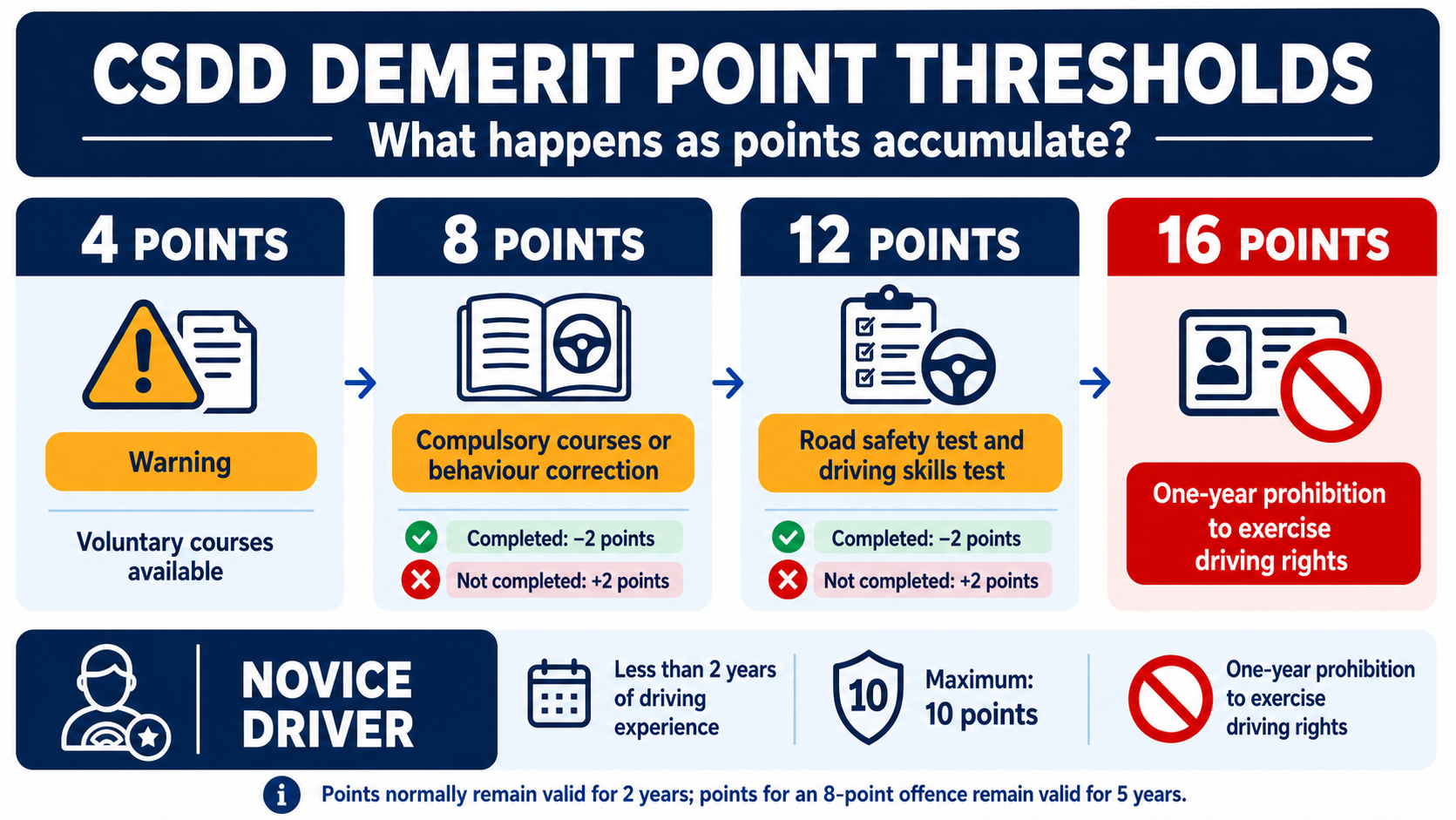
What happens at 4, 8, 12 or 16 points?
4 points: warning
At 4 points, the driver receives a warning. Before the mandatory measure for reaching 8 points is applied, the driver may voluntarily attend the road safety and safe driving courses. Two points are deducted after the full course has been completed.
8 points: compulsory courses or behaviour correction
At 8 points, CSDD selects one of two obligations, taking account of the nature of the registered offences:
- road safety and safe driving courses;
- driving behaviour correction group sessions.
The driver must apply within 2 months of the notice being sent and complete the measure within 6 months. Completion reduces the total by 2 points; failure to comply within the deadline adds 2 points.
12 points: two CSDD tests
At 12 points, the driver must pass a road safety test and a driving skills test. The driver must apply within 2 months and pass both tests within 6 months of the notice being sent.
The road safety test contains 20 questions, allows 20 minutes and permits no more than 2 incorrect answers. Passing both requirements reduces the total by 2 points; failure to comply within the deadline adds 2 points.
16 points: prohibition to exercise driving rights
The maximum is 16 points for a driver with at least 2 years of driving experience. Reaching this limit results in a one-year prohibition to exercise driving rights. The driving licence must be surrendered to CSDD within 20 days of the notice being sent.
After the prohibition expires, the driver must pass the theory and driving tests to renew their driving rights. Driving during the prohibition extends its term by the time elapsed between the start of the prohibition and the prohibited driving.
What is different for a novice driver?
For a driver with less than 2 years of driving experience, the maximum is 10 points, not 16. Reaching 10 points results in a one-year prohibition to exercise driving rights. After renewal, the driver's novice status is extended by a further year.
The lower maximum means that a novice driver can reach the critical threshold much sooner. For example, failing to comply with the measure assigned at 8 points and receiving another 2 points may bring the total to the 10-point maximum. It is therefore important to check every deadline immediately after receiving the notice.
What do the courses assigned at 8 points include?
If CSDD assigns road safety and safe driving courses, both parts must be attended. The road safety training lasts 10 hours and the safe driving training lasts 6 hours. Two points are deducted only after the full course has been completed, not after attending one part.
The road safety component examines traffic risks, compliance with the Road Traffic Regulations and the effects of a driver's decisions on other road users. The safe driving component focuses on practical responses to hazardous situations and vehicle-control skills.
If CSDD assigns driving behaviour correction group sessions after assessing the nature of the offences, their total duration is at least 10 hours. The aim is to help the driver recognise risky behaviour, its causes and the situations in which repeat offending is likely to occur.
The driver cannot choose whichever of the two measures is more convenient. CSDD decides on the appropriate measure from the registered offences. Application details and the precise venue must be checked in the notice and in the current information published by CSDD.
Can demerit points be removed earlier?
Yes, but only in the cases provided by law. Completing the full voluntary course or successfully completing an assigned compulsory measure can reduce the total by 2 points. Each specific measure may reduce points only once during one points cycle.
A cycle runs from the registration of the first point until all points are deleted or a prohibition to exercise driving rights is imposed. Points cannot be removed merely by paying a fine or repeatedly attending the same course.
How much do the courses and tests cost?
At the time this article was updated, the fees published by CSDD were:
- road safety part of the course – EUR 60.03;
- safe driving part of the course – EUR 207.19;
- driving behaviour correction group sessions – EUR 200;
- road safety test – EUR 11.40;
- driving skills test – EUR 50.57.
Where courses are assigned, 2 points are deducted only after both parts have been completed. Before applying, check the current fees and procedure in the CSDD demerit points section.
What should you do after receiving a CSDD notice?
Do not leave the notice until the final few weeks. Availability of course places, sessions or tests may not match the driver's preferred schedule, while the legal deadline continues to run regardless of work or personal commitments.
- Check the total in e-CSDD. Confirm which offences and measures are recorded.
- Read the entire notice. Note the date on which it was sent, the application deadline and the final completion deadline.
- Apply promptly. At 8 and 12 points, the driver must apply within 2 months and complete the requirement within 6 months.
- Keep payment and registration details. They may be needed if the status of the application has to be clarified.
- Complete every required element. Partial attendance or passing only one of two required tests is not full compliance.
- Check e-CSDD again afterwards. Data may not be updated instantly, but the driver should confirm that completion has been recorded.
If illness, an emergency or another objective problem may prevent compliance, do not wait for the deadline to expire. Contact CSDD promptly and establish which documents or further steps are required in the particular circumstances.
What happens if the maximum is reached again?
If a prohibition for reaching the maximum number of points is imposed again within 10 years, the person loses their driving rights. They may obtain them again no earlier than after 5 years and must complete all requirements for first-time acquisition, including driving school training and CSDD tests.
How are driving rights renewed after the one-year prohibition?
Driving rights are not restored merely because one year has elapsed. Once the prohibition has ended, the driver must apply to CSDD and pass the tests required for renewal. In most cases, this means the Category B theory and driving tests.
If the driver holds only AM, A1, A2, A or B1, the driving test is taken using a vehicle appropriate to the relevant category. A different testing procedure applies to a person holding only TRAM or TROL. Before applying, the driver should also check the validity of their medical certificate and any other restrictions recorded in their driver data.
Failing to surrender the licence or driving during the prohibition does not make the period end sooner. On the contrary, the prohibition may be extended. The licence must therefore be surrendered within the prescribed 20 days, and no vehicle may be driven while the prohibition is in force.
How can you avoid reaching the next threshold?
The purpose of the system is not only to penalise, but also to change risky driving behaviour before more serious consequences follow. When points have already been registered, it is useful to examine both the offence and the habits that led to it.
- allow more time for journeys so that haste does not encourage speeding or aggressive manoeuvres;
- regularly revise road signs, priority rules and safe-distance requirements;
- after drinking alcohol, do not rely on how you feel—use a taxi, public transport or a sober driver;
- if one type of mistake is recurring, take a lesson with an instructor to correct that specific driving habit;
- check e-CSDD periodically, particularly after a new decision has entered into force.
Frequently asked questions
Are points registered for every road traffic offence?
No. Points are registered only for offences listed in the annex to Cabinet Regulation No. 551. No more than 8 points may be registered for one offence.
Does paying the fine remove the points?
No. A fine and demerit points are separate consequences. Points are deleted when their validity period expires or reduced after a measure prescribed by law has been completed.
Where can I see when my points will expire?
Check the registered points and their current status in e-CSDD. Contact CSDD if the information appears inaccurate.
Are driving rights lost permanently at 16 points?
No. On reaching the maximum for the first time, a one-year prohibition to exercise driving rights is imposed. Loss of driving rights, with the possibility of obtaining them again after 5 years, applies when the maximum is reached for a second time within 10 years.
What should I do if I did not receive the CSDD notice?
Check your declared address, e-CSDD notice settings and current point total. Failure to read the notice does not suspend the deadline, so contact CSDD promptly if anything is unclear.
Can I appeal only the registered demerit points?
No. A separate decision on the registration of points is not issued. If the driver disputes the offence or the penalty, they must appeal the decision in the administrative offence case within the statutory deadline.
Are two points removed as soon as I register for a course?
No. The reduction is registered only after the assigned measure has been completed in full and the completion information has reached the register. An application, payment or attendance at only one part of the course is not sufficient.
Do all points have the same expiry date?
No. Each points entry relates to a specific offence and registration date. Different points can therefore expire on different dates. Check the current total in e-CSDD.
Refresh your knowledge of the Road Traffic Regulations
The most reliable way to avoid further points is to revisit the rules regularly and assess your driving habits honestly. You can practise with Presto's CSDD theory test. If you must obtain your driving rights again after reaching the maximum for a second time, see Presto's Category B training.