Road Traffic Regulations
Road Traffic Regulations have been issued in accordance with the requirements of Section 3, Paragraph two of the Road Traffic Law. Road Traffic Regulations are a legal act that determines the procedures for road traffic in Latvia. Road Traffic Regulations regulate the movement of road users, warn of danger, and determine orders and prohibitions for them when moving on Latvian roads and territories.
These Regulations define various terms and regulate various matters related to the movement of vehicles and less-protected road users on roads, determining their rights and obligations. The purpose of the Regulations is to improve road safety, especially the safety of less-protected road users. All road users must comply not only with what is written in the Road Traffic Regulations, but also with basic standards of courtesy and respect in order to be able to show tolerance towards other road users. This is necessary so that the actions of every road user in road traffic guarantee safety both for themselves and for other road users.
The published Cabinet Regulation No. 279, Road Traffic Regulations, is in force as of 26.01.2024.
Topics
1. General Provisions
1. These Regulations determine the procedures for road traffic in Latvia.
2. Terms used in these Regulations:
2.1. bypassing – driving past one or more vehicles that have been stopped completely or partially on the carriageway, as well as other obstacles (hindrances), where this is related to a change in the direction of travel;
2.2. overtaking – driving past one or more moving vehicles by entering the opposite lane (side of the carriageway) and returning to the previous lane (side of the carriageway);
2.3. built-up area – a built-up territory of a city or village where entry is indicated by road sign No. 519 or No. 555, and exit by road sign No. 520 or No. 556;
519. 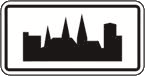 555.
555.  520.
520. 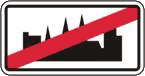 556.
556. 
2.4. stopping – stopping a vehicle for a period not exceeding five minutes, if this is necessary for passengers to get into or out of the vehicle, or for loading cargo into or unloading cargo from the vehicle;
2.5. passing – driving past one or more moving vehicles without entering the opposite lane (side of the carriageway);
2.5.1 alternatively fuelled vehicle – a motor vehicle powered wholly or partially by electricity, hydrogen, natural gas in gaseous state, natural gas in liquid state, biomethane, liquefied petroleum gas, or mechanical energy obtained from a storage device installed in the motor vehicle or from installed sources, including surplus heat;
2.5.2 zero-emission heavy-duty vehicle – a zero-emission heavy-duty vehicle as defined in point 11 of Article 3 of Regulation (EU) 2019/1242 of the European Parliament and of the Council of 20 June 2019 setting CO2 emission performance standards for new heavy-duty vehicles and amending Regulations (EC) No. 595/2009 and (EU) 2018/956 of the European Parliament and of the Council and Council Directive 96/53/EC;
2.6. dangerous goods – goods which, during carriage or storage, due to their properties, may cause an explosion, fire or other damage, as well as endanger human life or health;
2.7. traffic lane – any longitudinal lane of a carriageway (which may be marked with road markings) that is wide enough for cars to travel in one row;
2.8. carriageway – the part of a road intended for the movement of vehicles. A road may have several carriageways separated by central reserves or barriers;
2.9. give way – a requirement which means that a road user must not start driving (walking), continue driving (walking) or perform any manoeuvre if, by doing so, other road users are hindered in driving (walking) or are forced to change their direction or speed of driving (walking);
2.10. railway level crossing – a place where a road crosses a railway track bed at the same level. The boundary of a railway level crossing is an imaginary line that crosses the carriageway perpendicular to the axis of the road, starting from the railway level crossing barrier, or, if there is no such barrier, from road sign No. 134 or No. 135;
134. 135.
135. 
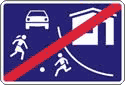
2.11. living zone – a built-up territory (residential area, recreation area) or part thereof where entry is indicated by road sign No. 533, and exit by road sign No. 534;
533. 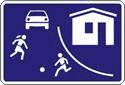 534.
534. 
2.12. electric vehicle – a motor vehicle which, by its design, uses as its only mechanical driving force energy from electricity stored in the vehicle or from an energy storage device for driving force;
2.13. actual mass – the mass of a vehicle together with the vehicle driver, passengers and cargo. For a towing vehicle with a trailer (semi-trailer), the actual mass is the sum of the actual masses of the towing vehicle and the trailer (semi-trailer);
2.14. main road – a road indicated by road sign No. 201, No. 203, No. 204 or No. 205, or a road on which no priority road signs are installed in relation to a road on which road sign No. 206 or No. 207 is installed, or a road with asphalt, asphalt concrete, cobblestone or similar surface in relation to a road with gravel or crushed-stone surface, or a road with any surface in relation to an unsurfaced road, or any road in relation to a place where a vehicle enters the road from an adjacent territory (courtyard, parking area, petrol station, undertaking, etc.). Within the meaning of this term, the surface of a less important road section immediately before a junction does not mean that the relevant road is of equal importance with the road it crosses;
201.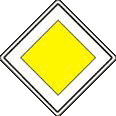 203.
203. 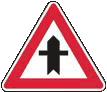 204.
204. 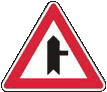 205.
205.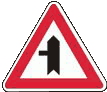 206.
206.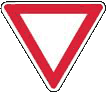 207.
207. 
2.15. pedestrian path – a separated road or part of a road intended for pedestrians and indicated by road sign No. 415;
415. 
2.16. pedestrian crossing – a part of a carriageway indicated by road signs No. 535 and No. 536 and/or road marking No. 931 and intended for pedestrians to cross the carriageway;
535. . 536.
  931.
931. 
2.17. pedestrian and bicycle path – a separated road or part of a road intended for pedestrians and for riding a bicycle or electric scooter and indicated by road sign No. 419 or No. 421;
419.  421.
421. 
2.18. footway – the part of a road intended for pedestrians. A footway is adjacent to the carriageway or separated from it;
2.19. shared pedestrian and bicycle path – a separated road or part of a road intended for mixed pedestrian, bicycle and electric scooter traffic and indicated by road sign No. 417;
417. 
2.20. junction – a place where roads intersect, join or branch at the same level, as well as a place where road traffic is organised by road sign No. 409. A junction is bounded by imaginary lines connecting the beginning of the curves of the opposite edges of the carriageways. This term does not apply to a place where a vehicle enters the carriageway from an adjacent territory (courtyard, parking area, petrol station, undertaking, etc.) or enters such territory;
409. 
2.21. shoulder – a part of the road adjacent to the carriageway and not intended for the movement of motor vehicles;
2.22. passenger public transport vehicle – a bus, trolleybus or tram travelling on a specified route;
2.23. forced stopping – stopping a vehicle due to a technical defect or due to danger caused by the state of health of the vehicle driver or passenger, the cargo being carried, or an obstacle on the road that is dangerous to road traffic;
2.24. priority – the right to proceed (walk) first in the intended direction in relation to other road users;
2.25. central reserve – a part of the road that separates adjacent carriageways or roads arranged in parallel (for example, pedestrian and bicycle paths) from one another and is not intended for the driving or stopping of vehicles;
2.26. traffic controller – a person who regulates road traffic and is authorised to do so;
2.27. parking – stopping a vehicle if it is not related to passengers getting into or out of the vehicle, loading cargo into or unloading cargo from the vehicle, as well as stopping a vehicle for a period exceeding five minutes if it is related to passengers getting into or out of the vehicle, loading cargo into or unloading cargo from the vehicle;
2.28. combination of vehicles – a motor vehicle connected to a trailer (semi-trailer), as well as a connected towing and towed vehicle;
2.29. bicycle lane – a lane on the carriageway intended for riding a bicycle and an electric scooter and separated from the lane of other vehicles by road marking No. 920 or No. 925 or by a raised kerb (it is marked with road marking No. 941; it may be indicated by road signs No. 413 and No. 817);
920.  925.
925. 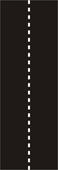 941.
941.  413.
413. 817.
817. 
2.30. bicycle path – a separated road or part of a road intended for riding bicycles and electric scooters and indicated by road sign No. 413 and road marking No. 932 or No. 941.
413. 932.  941.
941.
3. The movement of special military equipment of the National Armed Forces on a road is permitted:
3.1. if the relevant road sections are closed in accordance with the procedures laid down in the laws and regulations on road traffic;
3.2. if the special military equipment is escorted by the Military Police;
3.3. if the special military equipment has a white light lamp (lamps) switched on at the front, a red light lamp (lamps) switched on at the rear, as well as an additional flashing orange (yellow) beacon switched on, which is visible both from the front and from the rear.
4. Driving temporarily on a road outside built-up areas, if this is necessary for crossing a road or bridge, is permitted for mopeds, tricycles, quadricycles and motorcycles the use of which in road traffic has not been intended by the manufacturer, as well as for snowmobiles registered in the national register of vehicles and their drivers in accordance with the laws and regulations on vehicle registration, and for special tractor machinery registered in the State information system of tractors and their drivers, but which their manufacturer has not intended for use in road traffic. When participating in road traffic with such a vehicle, its driver must do everything possible to ensure road traffic safety.
5. Road users are prohibited from:
5.1. damaging, arbitrarily removing or installing road signs, traffic lights or other technical means for road traffic organisation or control;
5.2. damaging, polluting or littering the road.
6. If a road user has polluted or littered the carriageway (cargo has fallen out, oil has spilled, etc.), he or she must clean it immediately, but if this is not possible, must warn other road users and notify the police.
2. Obligations of Pedestrians and Passengers
7. Pedestrians shall move along a sidewalk, pedestrian path, pedestrian and bicycle path or combined pedestrian and bicycle path, but, if there is none, along the shoulder. If there is no sidewalk, pedestrian path, pedestrian and bicycle path, combined pedestrian and bicycle path or shoulder, or if it is not possible to move along it, pedestrians are allowed to move along the edge of the carriageway in a single file (on roads with a central reservation, along the outer edge). If no road works are being carried out and the permitted driving speed does not exceed 30 km/h, pedestrians are allowed to move along the edge of the carriageway in more than one file, but in no more than three files.
8. It is allowed to move along a sidewalk, pedestrian path, pedestrian and bicycle path, combined pedestrian and bicycle path or shoulder using roller skates, skateboards and similar sports or recreational equipment, provided that this does not hinder other road traffic participants. It is allowed to cross the carriageway using roller skates, a skateboard and similar equipment at a speed that does not exceed pedestrian walking speed.
9. Pedestrians who walk along the edge of the carriageway or shoulder outside built-up areas shall move facing the direction of vehicle traffic. Persons who use a wheelchair or push a motorcycle, moped, bicycle and similar along the edge of the carriageway or shoulder are allowed to move on either side of the road.
10. During the hours of darkness, if the road is not sufficiently and evenly lit, pedestrians who are on the carriageway or shoulder must wear a reflective vest or clothing with clearly visible elements made of light-reflecting material.
11. Organised groups of people may move only along the right side of the road in the direction of vehicle traffic, in a group of no more than four people in a row. At the front left side and at the rear left side of the organised group of people there must be persons wearing a reflective vest or clothing with clearly visible elements made of light-reflecting material, and during the hours of darkness and in conditions of insufficient visibility also with lit lamps: a white light at the front and a red light at the rear.
12. Groups of children may move along sidewalks, pedestrian paths, pedestrian and bicycle paths or combined pedestrian and bicycle paths, but, if there are none, only during the daylight hours along the shoulder on the right side of the road in the direction of vehicle traffic, in a column of no more than two children in a row. At the front left side and at the rear left side of the group of children there must be adults wearing a reflective vest or clothing with clearly visible elements made of light-reflecting material.
13. Pedestrians shall cross the carriageway at pedestrian crossings (underground or surface-level), but, if there are none, at intersections along the imaginary continuation of sidewalks or shoulders. If there is no pedestrian crossing or intersection within the pedestrian’s field of vision, it is allowed to cross the carriageway at a right angle to the edge of the carriageway, after first making sure that no vehicles are approaching.
14. At places where road traffic is regulated, pedestrians must follow the signals of the traffic controller or pedestrian traffic lights, but, if there are none, the signals of the traffic lights for regulating vehicle traffic (hereinafter — traffic lights).
15. Before crossing the carriageway at a pedestrian crossing in places where traffic is not regulated, pedestrians must assess the distance to approaching vehicles, assess their speed and make sure that it is safe.
16. Outside a pedestrian crossing in places where traffic is not regulated, pedestrians may step onto the carriageway only after they have assessed the distance to approaching vehicles and their speed and have made sure that crossing the carriageway is not dangerous and that vehicle traffic will not be hindered.
17. Pedestrians shall not linger on the carriageway or stop without necessity. Pedestrians who have not managed to cross the carriageway must, where possible, stop on a "safety island". Pedestrians may continue crossing the carriageway only after they have made sure that it is not dangerous.
18. Pedestrians are prohibited from:
18.1. crossing the carriageway in places where pedestrian barriers or road barriers have been installed, except for places where specially arranged gaps intended for crossing the road have been made in the barriers;
18.2. crossing the carriageway outside a pedestrian crossing if the carriageway has four or more traffic lanes and there is no central reservation;
18.3. (deleted by Cabinet Regulation No. 56 of 16 January 2024);
18.4. stepping onto the carriageway from behind a stationary vehicle or another obstacle that restricts visibility without making sure that no vehicles are approaching.
19. If an emergency vehicle is approaching with a flashing blue beacon or a blue and red beacon switched on and a special audible signal switched on, pedestrians are prohibited from stepping onto the carriageway, and pedestrians who are on the carriageway must give way to the said vehicle.
20. It is allowed to wait for a public passenger transport vehicle only on boarding platforms, but, if there are none, on the sidewalk or shoulder.
21. At public passenger transport stops where there are no boarding platforms, it is allowed to step onto the carriageway in order to board a public passenger transport vehicle only after it has come to a complete stop. After alighting from a public passenger transport vehicle, pedestrians must clear the carriageway.
22. Passengers are allowed to get into and out of a vehicle only after the vehicle has come to a complete stop. This must be done from the side of the sidewalk, boarding platform or shoulder. If it is not possible to get into or out of a non-rail vehicle from the side of the sidewalk, boarding platform or shoulder, this may be done from the side of the carriageway, provided that it is not dangerous and does not hinder the movement of other vehicles.
23. Passengers whose seats are equipped with seat belts must be fastened while travelling. Passengers on motorcycles, tricycles, quadricycles and mopeds (except where the vehicle has a closed body) must wear a fastened protective helmet on their head while travelling.
24. Passengers are prohibited from:
24.1. disturbing the driver of the vehicle or distracting the driver while driving;
24.2. opening the doors of a vehicle if this endangers road traffic safety or hinders other road traffic participants;
24.3. leaving their seat without an invitation if the vehicle has been stopped at the request of an official of the competent authority.
3. Obligations of Drivers
25. A driver of a vehicle has the following obligations:
25.1. before setting off, to check whether the vehicle is in good technical condition and whether it is equipped in accordance with the requirements referred to in Paragraphs 218, 219 and 220 of these Regulations;
25.2. to monitor the technical condition of the vehicle while on the road;
25.3. to do everything possible to avoid endangering other road traffic participants, especially the less protected ones (pedestrians, bicycle riders and electric scooter riders);
25.4. when driving a motor vehicle whose design provides for seat belts, to wear a seat belt and not to carry passengers who are not wearing seat belts (this applies to all passengers whose seats are equipped with seat belts);
25.5. when driving a moped, motorcycle, tricycle or quadricycle, to ride with a fastened protective helmet on the head, and also not to carry passengers who do not have a fastened protective helmet on the head (except where the vehicle has a closed body);
25.6. in the event of a forced stop under conditions of insufficient visibility and during the dark hours of the day, when going out onto the carriageway or being on the shoulder, to wear a reflective vest or clothing with clearly visible elements of light-reflecting material;
25.7. to stop the vehicle if a police officer, border guard, official of the municipal transport control service or customs official gives an instruction:
25.7.1. by means of a loudspeaker or by a swinging movement of a hand or baton directed at the specific driver of the vehicle from a car or motorcycle of the police, State Border Guard or State Revenue Service, whether or not it has the paint scheme of an emergency vehicle complying with the requirements laid down in the laws and regulations regarding vehicle registration;
25.7.2. by a horizontally extended hand or baton while being on (or by) the carriageway. At the same time, the official of the competent authority may use the other hand to give instructions as to which specific driver of a vehicle must stop the vehicle and where it must be stopped;
25.8. to remain in the seat and not to leave it without an invitation if the vehicle has been stopped at the request of an official of the competent authority;
25.9. to submit to inspections carried out by officials of the competent authority when they perform the supervision and control functions laid down in laws and regulations, including the request of a police or customs officer to deliver the vehicle to the place where the inspection is to be carried out, as well as to make the vehicle available for such inspections and to allow inspection of the equipment referred to in Paragraphs 218, 219 and 220 of these Regulations.
25.1 In addition to the requirements referred to in Paragraph 25 of these Regulations, the driver of tractor machinery has the obligation to stop the tractor machinery upon an instruction of an official of the State Technical Supervision Agency.
4. Obligations of a Driver in Special Cases
26. If an emergency vehicle is approaching with a flashing blue beacon and a special sound signal switched on, other road traffic participants must give way to it.
27. If an emergency vehicle is approaching with a flashing blue and red beacon and a special sound signal switched on, drivers of other vehicles travelling in the same direction and drivers of oncoming vehicles (if there is no road element constructed to separate the carriageway, for example a barrier or central reserve) must give way to it by stopping the vehicle by the footpath or on the shoulder, or, if it is occupied, as close as possible to the right-hand edge of the carriageway. Drivers of vehicles approaching an intersection (road) from roads in other directions must stop the vehicle before the carriageway to be crossed. Driving may be started (continued) only after the vehicle with a flashing blue beacon which is travelling behind the escorted vehicle (column) has passed.
28. When approaching a stationary emergency vehicle with a flashing blue beacon switched on, the driver of a vehicle must drive at such a speed that, if necessary, the vehicle can be stopped immediately.
29. Emergency vehicles may participate in road traffic only while carrying out urgent service tasks in order to:
29.1. save human life or material values, or prevent serious harm to a person’s health and damage to the environment;
29.2. prevent threats to public safety and order (including when travelling to the place of a criminal offence (incident));
29.3. follow a person fleeing from an emergency vehicle;
29.4. transport material values of especially large amount;
29.5. escort other vehicles (columns);
29.6. ensure the safe and unobstructed movement of a protected official.
30. In the cases referred to in Paragraph 29 of these Regulations, drivers of emergency vehicles may disregard the requirements of these Regulations, except for requirements established by traffic controller signals. The driver of an emergency vehicle must do everything possible to ensure road traffic safety. The rights and obligations referred to also apply to drivers whose vehicles are escorted by emergency vehicles.
31. The emergency vehicle travelling in front of the escorted vehicle (column) must travel with a flashing blue and red beacon and a special sound signal switched on. The vehicle travelling behind the escorted vehicle (column) must travel with a flashing blue beacon switched on.
32. In order to ensure the safe and unobstructed movement of a protected official, an emergency vehicle carrying out the protection (guarding) of protected officials has the right, when leaving the column, to block the way of a vehicle that poses a threat to the life or health of the protected official.
33. A flashing blue beacon switched on without a special sound signal switched on has only a warning meaning. It may be used to warn of an accident (for example, a road traffic accident), as well as when escorting a vehicle (column). Drivers whose vehicles have a flashing blue beacon switched on without a special sound signal switched on shall not violate the requirements of these Regulations, except for the rules on stopping and parking, as well as the prohibition referred to in Paragraph 98 of these Regulations for motor vehicles to drive on footpaths, pedestrian paths, bicycle paths, pedestrian and bicycle paths, or combined pedestrian and bicycle paths.
34. Drivers whose vehicles have a special paint scheme and have been granted the status of emergency vehicles shall not violate the requirements of these Regulations without a flashing blue beacon and a special sound signal switched on, except for the prohibitions referred to in Sub-paragraphs 121.4, 121.6, 121.7, 121.9, 121.10, 121.11, 121.12, 122.2, 122.3, 122.4 and 292.15 of these Regulations, and they are allowed to drive in lanes intended for public transport vehicles.
35. Drivers whose vehicles have been granted the status of emergency vehicles but do not have a special paint scheme, and who perform the service tasks referred to in Sub-paragraph 29.6 of these Regulations, shall not violate the requirements of these Regulations without a flashing blue beacon and a special sound signal switched on, except for the prohibitions referred to in Sub-paragraphs 121.4, 121.6, 121.7, 121.9, 121.11, 121.12, 122.3 and 122.4 of these Regulations, and they are allowed to drive in lanes intended for public transport vehicles.
36. A flashing orange (yellow) beacon switched on does not grant priority. It is used to draw the attention of other road traffic participants and warn them of possible danger. A flashing orange (yellow) beacon must be switched on by drivers who:
36.1. escort vehicles carrying especially heavy or oversized loads;
36.2. escort columns of vehicles carrying explosives, radioactive substances or highly toxic substances;
36.3. carry out road maintenance works on the road, as well as other repair works or works to eliminate the consequences of accidents;
36.4. drive tractor machinery with two trailers;
36.5. accompany bicycle riders during training sessions;
36.6. drive special military equipment in the case referred to in Sub-paragraph 3.3 of these Regulations.
37. If, when carrying out road maintenance, repair, emergency works or works to eliminate the consequences of a road traffic accident, drivers have switched on a flashing orange (yellow) beacon, they may disregard the requirements established by road signs and road markings and deviate from the requirements referred to in Paragraphs 85, 86, 87, 88, 92, 93, 95 and 97 of these Regulations, and, when carrying out road maintenance works, may also be on the side of the road intended for traffic in the opposite direction, if road traffic safety is ensured. Other drivers shall not hinder the work of the aforementioned drivers and must drive at such a speed that, if necessary, the vehicle can be stopped immediately.
38. A flashing orange (yellow) beacon may also be switched on in road traffic by drivers who drive vehicles which, by their design, are intended for specific tasks (oversized vehicles, tractor machinery and similar), vehicles used for specific tasks (technical assistance vehicles, road supervision vehicles and similar), as well as vehicles of utility services (electricity supply, heat supply and similar), if the presence of such vehicles on the road may cause obstruction or danger to other road traffic participants.
5. Actions of the Driver After a Road Traffic Accident
39. If people have been injured in a road traffic accident or damage has been caused to a third party's property (a vehicle involved in the road traffic accident whose owner is not the driver shall not be regarded as third party property), and also if vehicles have sustained damage due to which they cannot be driven or are prohibited from being driven, the driver of the vehicle shall:
39.1. stop immediately and remain at the scene of the accident, switch on the hazard warning lights and place the warning triangle, but, if this is not possible, warn other road traffic participants of the road traffic accident in another manner;
39.2. do everything possible to provide first aid to the injured person, call emergency medical assistance or the rescue service, but, if this is not possible, take the injured person to the nearest medical treatment institution in his or her own vehicle or another passing vehicle and return to the scene of the accident;
39.3. do everything possible to preserve traces of the event at the scene of the accident, and record the given name, surname and address of witnesses;
39.4. report the road traffic accident to the police and, if necessary, to the rescue service, and thereafter act according to their instructions.
40. If no people have been injured in a road traffic accident, no damage has been caused to third party property, and the vehicles have not sustained damage due to which they cannot be driven or are prohibited from being driven, the driver of the vehicle shall:
40.1. stop immediately and remain at the scene of the accident, switch on the hazard warning lights and place the warning triangle, but, if this is not possible, warn other road traffic participants of the road traffic accident in another manner;
40.2. agree with the driver of the other vehicle involved in the road traffic accident on all essential circumstances of the accident, complete the agreed statement and, without reporting the accident to the police, leave the scene of the accident.
41. If more than two vehicles are involved in the road traffic accident referred to in Paragraph 40 of these Regulations or if the drivers of the vehicles are unable to agree on all essential circumstances of the accident and complete the agreed statement, the drivers of the vehicles shall:
41.1. stop immediately and remain at the scene of the accident, switch on the hazard warning lights and place the warning triangle, but, if this is not possible, warn other road traffic participants of the road traffic accident in another manner;
41.2. report the road traffic accident to the police and, if necessary, to the rescue service, and thereafter act according to their instructions.
42. If the vehicles involved in a road traffic accident referred to in Paragraphs 39, 40 or 41 of these Regulations prevent or hinder other vehicles from passing the scene of the road traffic accident and this is not contrary to the instructions of the police, the drivers of the vehicles shall clear the carriageway, having first recorded the position of the vehicles involved in the road traffic accident and other objects.
43. If only one vehicle is involved in a road traffic accident, no people have been injured and no damage has been caused to third party property, the driver of the vehicle may leave the scene of the accident without reporting the accident to the police.
6. Road Traffic Control
44. Traffic shall be controlled by:
44.1. traffic lights (Annex 1), which have green, yellow, red and white light signals. Traffic lights shall be manufactured and installed in accordance with the requirements of the standards LVS EN 12368:2015 "Traffic control equipment. Signal heads" and LVS 370:2010 "Road traffic control signal heads";
44.2. traffic regulators.
45. Traffic light signals have the following meaning:
45.1. green signal allows to move. In order to inform road traffic participants that the time of operation of the green signal is ending and a prohibition signal will light on soon, green blinking signal may be used. In order to inform road traffic participants of the time (in seconds) which has remained until the end of the operation of green signal, information board may be used;
45.2. yellow signal prohibits movement, except for the cases referred to in Paragraph 54 of this Regulation, and warns of expected change of signals;
45.3. yellow blinking signal or two alternatively blinking yellow signals allow the movement and inform of non-controlled crossroad, pedestrian crossing, place of roadworks or other dangerous road section. To inform of a non-controlled pedestrian crossing or place where the traffic is not regulated and carriageway is crossed by bicycle path, pedestrian and bicycle path or combined pedestrian and bicycle path, yellow blinking signal or two alternatively blinking yellow signals may be used with a silhouette of a person, bicycle symbol or silhouette of a person and bicycle symbol accordingly;
45.4. red signal (also blinking) or two alternatively blinking red signals prohibits movement. In order to inform of the duration of the red signal being alight, a plate of descriptive content may be placed under the traffic signal or its section;
45.5. red signal together with yellow signal prohibits movement and informs that green signal will light on;
45.6. green arrow (arrows) signal on black background allows to drive in the indicated direction (directions). Green arrow in the additional section of the traffic lights has the same meaning, moreover the arrow which allows to turn to the left also allows to make a U-turn. If green arrow signal in the additional section of the traffic lights is switched off, vehicles are prohibited from driving in the respective direction;
45.7. black arrow (arrows) on red and yellow signal background does not change the meaning of these signals. They inform of permitted driving directions when the signal of green arrow (arrows) on black background will switch on;
45.8. black arrow (arrows) on green signal background indicates that traffic lights have additional section, and also allows to drive in the directions indicated by the arrow (arrows);
45.9. red cross signal on black background informs that a prohibitive signal is alight in the traffic lights for the drivers of oncoming vehicles.
46. A traffic light signal with a pedestrian silhouette or bicycle symbol applies only to pedestrians, cyclists and electric scooter riders. In the cases referred to in Paragraphs 202 and 212.2 of these Regulations, when a cyclist or electric scooter rider crosses the carriageway on a controlled pedestrian crossing, he or she shall observe the traffic light signal intended for pedestrians.
47. In order to inform blind pedestrians of the location of the button for changing traffic light signals, and also to inform pedestrians, cyclists or electric scooter riders of the traffic light signal that permits crossing the carriageway, the light signals of pedestrian traffic lights or pedestrian and bicycle traffic lights may be supplemented with sound signals.
48. Traffic lights with a red "X" signal, a green downward arrow signal and a yellow diagonally downward arrow signal may be used to control vehicle traffic in a lane (traffic lights with a continuous signal display period for lane traffic control). These signals have the following meanings:
48.1. a red "X" signal prohibits driving in the lane above which it is placed;
48.2. a green downward arrow signal permits driving in the lane above which it is placed;
48.3. a yellow diagonally downward arrow signal indicates that the driver must immediately change lanes to the lane indicated by the arrow.
49. If the traffic light signals referred to in Paragraph 48 of these Regulations are switched off, it is prohibited to enter the lane above which the traffic light is placed.
50. Traffic lights with four white light signals arranged in the shape of the letter "T" may be used to control tram traffic. Driving is permitted only if, at the same time as the lower signal, one or more upper signals are also illuminated, of which the left signal permits driving to the left, the middle signal permits driving straight ahead and the right signal permits driving to the right. If only the three upper signals are illuminated, driving is prohibited.
51. The signals of traffic regulators have the following meanings:
51.1. arms extended to the sides or lowered:
51.1.1. from the left and right sides, trams may drive straight ahead, off-track vehicles may drive straight ahead and to the right, and pedestrians may cross the carriageway;
51.1.2. from the front and rear, all vehicles are prohibited from driving and pedestrians are prohibited from crossing the carriageway;
51.2. right arm extended forward:
51.2.1. from the left side, trams may drive to the left and off-track vehicles may drive in all directions;
51.2.2. from the front, all vehicles may drive only to the right;
51.2.3. from the right side and rear, all vehicles are prohibited from driving;
51.2.4. pedestrians may cross the carriageway behind the traffic regulator;
51.3. arm raised upwards – vehicles are prohibited from driving and pedestrians are prohibited from crossing the carriageway, except in the cases referred to in Paragraph 54 of these Regulations.
52. A traffic regulator may also give other signals that are understandable to drivers of vehicles and pedestrians. For better visibility, a traffic regulator may use a traffic baton. To draw the attention of road traffic participants, a traffic regulator may give a whistle signal.
53. If the signals of a traffic regulator or traffic lights, except for the traffic lights referred to in Paragraph 48 of these Regulations, prohibit driving, the driver of a vehicle shall stop the vehicle directly before the stop line (road marking No. 929) or sign No. 546. If there is no stop line (road marking No. 929) or sign No. 546, the vehicle shall be stopped in the following places:
929.  546.
546. 
53.1. before intersections and on other road sections – before a pedestrian crossing, but in places where there is none – before the traffic lights (if driving is prohibited by the signal of a traffic regulator – before the place where carriageways intersect) so as not to hinder other vehicles and pedestrians whose movement is permitted;
53.2. before level crossings – in accordance with Paragraph 155 of these Regulations.
54. If, when the yellow signal lights up or when the traffic regulator raises his or her arm upwards, the driver of a vehicle can stop the vehicle at the places referred to in Paragraph 53 of these Regulations only by braking sharply, the driver of this vehicle may continue driving without stopping the vehicle. Pedestrians who are on the carriageway at that moment shall finish crossing it or stop on a "safety island".
55. Drivers of vehicles and pedestrians shall obey the signals and instructions of a traffic regulator even if they contradict the requirements of traffic light signals, road signs or road markings.
56. An official who gives an instruction to stop a vehicle shall wear a uniform with elements of light-reflecting material and an insignia. If stopping is carried out from the vehicles referred to in Sub-paragraph 25.7.1 of these Regulations, elements of light-reflecting material are not mandatory.
7. Start of Driving and Change of Driving Direction
57. Before any manoeuvre – starting to drive, changing lanes, turning, making a U-turn, overtaking, stopping the vehicle, etc. – the driver must make sure that road traffic safety is ensured and that other road traffic participants will not be hindered, and must give a warning signal with the direction indicators in good time. If there are no direction indicators or they are not working, the warning signal must be given by hand according to the manoeuvre.
58. The left-turn signal is a straight left arm raised sideways at shoulder level, or the right arm raised sideways and bent upward at the elbow at a right angle.
59. The right-turn signal is a straight right arm raised sideways at shoulder level, or the left arm raised sideways and bent upward at the elbow at a right angle.
60. The braking signal is a raised left or right arm. A bicycle rider is allowed not to give a braking signal.
61. A hand signal must be given unambiguously so that other road traffic participants can see it clearly.
62. A signal with direction indicators or by hand must be given in good time before the manoeuvre begins and must be stopped immediately after the manoeuvre is completed (a hand signal may be stopped immediately before the manoeuvre). A signal must not be given if it may mislead other road traffic participants.
63. Before turning to the left or turning in the opposite driving direction, a warning signal must be shown only after the driver has ascertained that he or she will not disturb any driver who is driving behind him or her and who has started overtaking.
64. The use of a signal does not give the driver priority and does not release him or her from the obligation to exercise caution.
65. When entering a road from adjacent areas (courtyards, parking areas, petrol stations, undertakings, etc.), the driver must give way to pedestrians and other road traffic participants moving along the road.
66. When leaving a road to enter an adjacent area, the driver must give way to pedestrians and other road traffic participants whose path he or she crosses.
67. In built-up areas, a driver must give way to trolleybuses and buses starting to move from a marked stop. Trolleybus and bus drivers may start moving from the stop only after making sure that they are being given way.
68. When changing lanes, the driver must give way to vehicles travelling alongside without changing direction. When vehicles travelling in the same direction change lanes at the same time, the driver must give way to the vehicle on the right.
69. Outside intersections, where a tram track bed crosses the carriageway for non-rail vehicles, the tram has priority.
70. Before turning right, turning left or making a U-turn, the driver of a non-rail vehicle must, on the carriageway intended for non-rail vehicles, take the appropriate extreme position intended for travelling in the relevant direction in good time, except when turning to enter an intersection where traffic must proceed around a roundabout (sign No.409). Outside built-up areas, moped drivers are also allowed to turn left or make a U-turn from the right edge of the carriageway, giving way to vehicles travelling in the same and opposite directions.
409.
71. If a tram track bed is located to the left of the traffic lane at the same level as it, a left turn or U-turn must be made from the leftmost position taken on the tram track bed in the same direction.
72. If, at an intersection, the number of lanes and the driving directions in them are determined by signs No.513–518, it is prohibited to drive onto the tram track bed, except when it is included in a traffic lane determined by the said signs.
513. 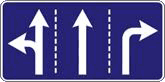 514.
514.  515.
515.  516.
516.  517.
517.  518.
518.
73. A turn must be made so that, when leaving the crossing of carriageways, the vehicle is not on the side intended for the opposite direction of travel.
74. If a tram track bed is separated from the rest of the carriageway or is not at the same level as it, the tram track bed may be crossed only at places intended for that purpose.
75. If, due to the dimensions of the vehicle or for other reasons, it is not possible to turn from the appropriate extreme position, a deviation from this requirement is allowed, provided that it does not hinder the movement of other vehicles.
76. When turning left or making a U-turn outside an intersection, the driver of a non-rail vehicle must give way to oncoming vehicles and to vehicles that have started overtaking.
77. If a carriageway is not wide enough to make a U-turn from the leftmost position, it is permitted to do so from the right edge of the carriageway or the right shoulder without hindering other road traffic participants. In such a case, the driver making a U-turn must give way to vehicles travelling in the same direction and to oncoming vehicles.
78. If the paths of vehicles cross and the order of movement is not regulated by these Regulations, the driver who has a vehicle approaching from the right must give way.
79. If a deceleration lane has been provided, a driver who intends to turn must change lanes to that lane in good time, and may reduce speed only when on it.
80. If an acceleration lane has been provided for entering a road, the driver must drive along it and merge into the traffic flow, giving way to vehicles travelling on that road.
81. Making a U-turn is prohibited at the following places:
81.1. on pedestrian crossings;
81.2. in tunnels;
81.3. on bridges, flyovers, road overpasses and under them;
81.4. on railway level crossings;
81.5. at places where road visibility in at least one direction is less than 100 m.
82. When reversing, the driver must not hinder other road traffic participants. If necessary for road traffic safety, the driver must ask another person for assistance in carrying out this manoeuvre.
8. Positioning of Vehicles on the Carriageway
83. The number of lanes intended for the movement of non-rail vehicles is indicated by the relevant road markings or road signs, but, if there are none, the number of traffic lanes is determined by drivers themselves, taking into account the width of the carriageway, vehicle dimensions and the necessary intervals between vehicles.
84. On roads where traffic is organised in two directions and there are four or more traffic lanes, as well as on roads with one traffic lane in each direction where there is a tram track bed in the middle of the carriageway, it is prohibited to enter the side of the road intended for traffic in the opposite direction, except where it is crossed during a left turn or a U-turn manoeuvre.
85. Outside built-up areas, vehicles shall be driven as close as possible to the right edge of the carriageway. If there are two or more lanes for traffic in one direction, entering the leftmost lane is allowed only if other lanes are occupied, and also to turn left or make a U-turn.
86. In built-up areas, if there are three or more lanes for non-rail vehicles in one direction, entering the leftmost lane is allowed only in the following cases:
86.1. if other lanes are occupied;
86.2. to turn left or make a U-turn;
86.3. to stop the vehicle on a one-way road.
87. In built-up areas where there are three or more lanes for traffic in one direction, lorries and combinations of vehicles whose gross mass exceeds 3.5 t are allowed to enter the leftmost lane only to turn left, make a U-turn or stop the vehicle on a one-way road for loading or unloading cargo.
88. Vehicles which are prohibited from exceeding, or which for technical reasons are unable to exceed, a driving speed of 40 km/h, tractor machinery and special military equipment shall drive only in the rightmost lane. The aforementioned vehicles, tractor machinery and special military equipment are allowed to enter another lane only to overtake, pass, bypass, change lanes before turning left, or make a U-turn.
89. If traffic in the lanes is heavy, when bypassing or passing, it is allowed to drive on the tram track bed in the same direction in places where the track bed is located on the left at the same level as the carriageway. In such a case, tram movement shall not be hindered.
90. If the number of lanes and the directions of travel at an intersection are determined by signs Nos. 513–518, driving on the tram track bed in the intersection is prohibited, except where it is included in any traffic lane determined by those signs.
513. 514. 515. 516. 517. 518.
91. It is prohibited to drive on the tram track bed intended for traffic in the opposite direction.
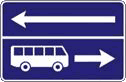
92. If a road is marked with sign No. 505, 507, 509 or 510, drivers of other vehicles are prohibited from driving in the lane intended for passenger public transport vehicles and from stopping a vehicle in this lane, except for two-wheeled mopeds and motorcycles, taxis, duly registered electric vehicles fitted with special-purpose vehicle state registration number plates, and, if any of the above signs is installed together with additional sign No. 824, also bicycles and electric scooters. Local governments, by a relevant decision, are entitled to determine a period during which vehicles may be stopped in a lane intended for passenger public transport vehicles in order to load or unload cargo.
505.  507.
507.  509.
509. 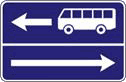 510.
510.  824.
824. 
93. If a lane for passenger public transport vehicles is marked with sign No. 505 and road marking No. 940, is arranged on the right side of the carriageway and is not separated from the rest of the carriageway by a continuous road marking line, a driver shall turn right from this lane. A driver is prohibited from driving in this lane for a prolonged period and shall turn into the nearest carriageway or at the place where the road exits to an adjacent territory. It is also allowed to enter this lane for passengers to get into or out of a vehicle, if this does not hinder the movement of passenger public transport vehicles or taxis, and also to turn right onto a road with such a lane.
505. 940. 
94. If a bicycle lane marked with road marking No. 941 (and/or also with sign No. 413) is arranged on the carriageway and is separated from the rest of the carriageway by a wide road marking No. 920, drivers of other vehicles are prohibited from driving in the bicycle lane and are allowed to cross it only where road marking No. 920 is interrupted.
941. 413. 920.
95. If a carriageway is divided into lanes by road marking lines, a driver must drive only within the lanes. Driving onto broken road marking lines is allowed only when changing lanes.
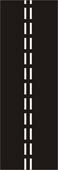
96. When turning onto a road marked with sign No. 748, a driver is prohibited from entering a lane marked on both sides with road marking No. 927. It is allowed to enter this lane only after passing the first traffic light referred to in Paragraph 48 of this Regulation installed after the intersection.
748.  927.
927. 
97. In heavy traffic conditions, when all traffic lanes are occupied, changing lanes is allowed only to turn, make a U-turn, bypass, or stop the vehicle.
98. Motor vehicles are prohibited from driving on footways, pedestrian paths, bicycle paths, pedestrian and bicycle paths, combined pedestrian and bicycle paths, as well as bicycle lanes, except for road maintenance and public utility service vehicles (for example, electricity supply and heat supply vehicles), if they are carrying out road maintenance, repair or accident clean-up works, and specialised tourist vehicles (except on footways). Local governments, by a relevant decision, are entitled to determine a period during which vehicles serving trade or other undertakings or carrying out work related to property management (for example, delivering goods or construction materials) at sites located directly next to these roads are allowed to drive and park on these roads (including the parking duration), if there are no other access possibilities, the movement of pedestrians and cyclists is not hindered, and the gross mass of the relevant vehicles does not exceed 5 t. When parking the vehicle, information about the time when the vehicle was parked shall be placed inside the vehicle at the front windscreen.
9. Driving Speed, Distance and Interval
99. A vehicle driver shall drive at a speed that does not exceed the prescribed limits, taking into account road traffic intensity, the characteristics and condition of the vehicle and load, as well as road and weather conditions (especially visibility in the direction of travel).
100. If obstacles dangerous to road traffic or other hazards arise which the driver of a vehicle is able to notice, he or she shall reduce the driving speed or stop the vehicle completely, or, without endangering other road traffic participants, bypass the obstacle.
101. In built-up areas, the driving speed of all vehicles shall not exceed 50 km/h, but in Living zones, courtyards of multi-apartment buildings, fuel station and parking areas – 20 km/h. Outside built-up areas, the driving speed of all vehicles shall not exceed 90 km/h.
102. On road sections where the relevant road signs have been installed, vehicles, subject to the conditions referred to in Paragraph 99 of these Regulations, may be driven at a speed not exceeding the speed indicated on the road sign.
103. In other cases not referred to in Paragraphs 101 and 102 of these Regulations, the driving speed of vehicles shall not exceed:
103.1. when carrying passengers outside the cabin in lorries intended for special work, where passenger seats are installed in the van-type cargo compartment – 60 km/h;
103.2. when towing motor vehicles – 50 km/h;
103.3. when towing the technological units – trailers – referred to in Paragraph 182 of these Regulations – 40 km/h;
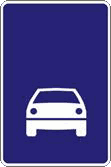
103.4. when driving on a road marked with sign No. 552, for motorcycles, tricycles, quadricycles, passenger cars and lorries whose maximum authorised mass does not exceed 7.5 t – 120 km/h, for buses – 110 km/h, but during the period from 1 December to 1 March, for motorcycles, tricycles, quadricycles, lorries whose maximum authorised mass does not exceed 7.5 t, and buses – 100 km/h, but for passenger cars – 110 km/h;
552. 
103.5. when driving on a road with a gravel or crushed-stone surface – 80 km/h;
103.6. for mopeds – 45 km/h;
103.7. for specialised refuse collection vehicles – 20 km/h, if a passenger is outside the cabin in the standing place intended for this purpose;
103.8. for electric scooters – 25 km/h.
104. A vehicle driver is prohibited from:
104.1. exceeding the maximum driving speed determined by the vehicle manufacturer;
104.2. exceeding the driving speed indicated on the identification sign on the vehicle in accordance with the requirements referred to in Paragraph 238 of these Regulations;
104.3. obstructing road traffic by driving too slowly without need;
104.4. braking sharply if this is not necessary for road traffic safety.
105. Depending on the driving speed, a vehicle driver shall choose such a distance that, if the vehicle in front brakes, it is possible to avoid a collision, and shall also choose such an interval as ensures road traffic safety.
106. Outside built-up areas, drivers of the vehicles (combinations of vehicles) referred to in Paragraphs 241 and 243 of these Regulations shall maintain such a distance between their vehicle and the vehicle in front that, expressed in metres, is not less than half of the vehicle's driving speed. This requirement does not apply if the vehicle driver is preparing to overtake, or in conditions of heavy road traffic.
10. Overtaking, Meeting Oncoming Vehicles and Passing
107. Before starting overtaking, the driver of a vehicle shall make sure that:
107.1. no driver of a vehicle travelling behind him or her, whom he or she could hinder, has begun overtaking;
107.2. the driver of the vehicle travelling ahead in the same lane is not indicating a left turn;
107.3. oncoming vehicles will not be hindered during overtaking;
107.4. after overtaking, he or she will be able to return to the previous lane (side of the carriageway) without hindering the vehicle being overtaken.
108. The driver of the vehicle being overtaken is prohibited from hindering overtaking (for example, by increasing the driving speed, etc.).
109. It is prohibited to overtake in the following places:
109.1. at controlled crossroads;
109.2. at uncontrolled crossroads, except when overtaking on the main road in relation to the crossing road;
109.3. on level crossings and within 100 m before them;
109.4. at the ends of uphill road sections, on dangerous bends and on other road sections where visibility is restricted by stopped vehicles, buildings, plantings, etc.;
109.5. on pedestrian crossings, at places where the carriageway is crossed by a bicycle path, a pedestrian and bicycle path or a combined pedestrian and bicycle path, and in tunnels.
110. In order not to hinder other road traffic participants and to let another vehicle pass, the vehicles referred to in Paragraph 88 of these Regulations may temporarily drive on the road shoulder if it has an asphalt or asphalt-concrete surface. If, outside built-up areas, the width of the road or the condition of the carriageway, taking into account the intensity of oncoming vehicle traffic, does not allow a slow-moving vehicle referred to in Paragraph 88 of these Regulations to be overtaken, its driver shall, without hindering other road traffic participants, drive as close as possible to the right edge of the road (shoulder), but, if congestion has formed behind the vehicle, stop the vehicle and let the vehicles that have formed the congestion behind it pass.
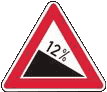
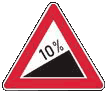
111. If passing an oncoming vehicle is difficult, the driver of the vehicle on whose side the obstacle (hindrance) is located shall give way to the oncoming vehicle. If there are obstacles on steep ascents or descents marked with road signs No. 110 and No. 111, the driver of the vehicle travelling downhill shall give way.
110. 111.
111. 
112. To draw the attention of the driver of the vehicle being overtaken, it is permitted to signal by switching headlamp beams in accordance with the requirements referred to in Paragraph 170 of these Regulations.
113. Outside built-up areas, on roads with two or more lanes in one direction, it is prohibited to pass on the right a vehicle driving ahead in the same lane, except when it is indicating a left turn and has begun the manoeuvre.
11. Stopping and Parking
114. Stopping and parking of vehicles is permitted on the right-hand side of the road, as far to the right as possible on the shoulder, but if there is no shoulder – at the edge of the carriageway in places where it is possible to pull in without violating the requirements of these Regulations. If extensions intended for this purpose have been created at the edge of the carriageway, stopping and parking of vehicles is permitted in these extensions.
115. In built-up areas, stopping and parking is also permitted on the left-hand side of the road, as far to the left as possible on the shoulder, but if there is no shoulder – at the edge of the carriageway or in its extensions on the following roads:
115.1. on roads with one driving lane in each direction, if there is no tram track bed in the middle of the carriageway;
115.2. on one-way roads (for lorries and combinations thereof whose full mass exceeds 3.5 t – only for loading or unloading cargo).
116. Vehicles may be stopped and parked in one row parallel to the edge of the carriageway. Motorcycles without a sidecar, two-wheeled mopeds, bicycles and electric scooters may be parked in two rows.
117. In parking places by a pavement or when driving onto a pavement, if the parking place is marked with road sign No. 529, 537 or 539 and supplementary sign No. 830–839, motorcycles, tricycles, quadricycles and passenger cars without trailers may be parked in the manner indicated therein, but if the parking place is marked with supplementary sign No. 830 or 831 – also passenger cars with trailers, as indicated by the relevant supplementary sign and road markings. In parking places on a pavement, vehicles shall be placed in one row as close to the carriageway as possible. Bicycles, electric scooters, two-wheeled mopeds and motorcycles without a sidecar may be parked on a pavement if this does not hinder pedestrian movement.
529. 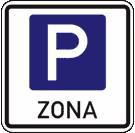 537.
537.  539.
539.  830.
830.  831.
831.  832.
832.  833.
833.  834.
834.  835.
835.  836.
836.  837.
837. 838.
838.  839.
839. 
118. Leaving a vehicle on the road for a long time is prohibited. Long-term parking (resting, overnight stay, etc.) outside built-up areas is permitted only in parking areas or outside the boundaries of the road.
119. A vehicle driver may leave the driver's seat only if everything necessary has been done to prevent the vehicle from moving from its place, and may leave the vehicle only if the possibility of using it without the vehicle driver's knowledge has also been prevented.
120. It is prohibited to open the doors of a vehicle if this endangers road traffic safety or hinders other road traffic participants.
121. Unless otherwise indicated by road signs or road markings, stopping and parking is prohibited:
121.1. on a tram track bed or in its immediate vicinity if this hinders tram traffic;
121.2. on level crossings and in tunnels;
121.3. on bridges, flyovers, road overpasses and beneath them;
121.4. in places where the distance between a solid road marking line on the carriageway, a central reserve or the opposite edge of the carriageway and a stopped vehicle is less than 3 m;
121.5. on pedestrian crossings, in places where the carriageway is crossed by a bicycle path, a pedestrian and bicycle path or a combined pedestrian and bicycle path, and closer than 5 m from these places;
121.6. at an intersection and closer than 5 m from it, except for stopping and parking opposite the side road at a three-way intersection where there is a solid road marking line No. 920 or No. 921 or a central reserve. The requirements referred to in this sub-paragraph do not apply to places where vehicles enter the carriageway from an adjacent territory (courtyard, parking place, fuel station, undertaking, etc.);
920. 921. 
121.7. closer than 25 m before and 10 m after road sign No. 541 or No. 542, and also in taxi stands marked with road sign No. 543, except where this is necessary for passengers to board or alight from the vehicle and if this does not hinder passenger public transport or taxi traffic;
541.  542.
542.  543.
543. 
121.8. in places where the vehicle obscures traffic light signals or road signs from other vehicle drivers;
121.9. on pavements, pedestrian paths, pedestrian and bicycle paths, combined pedestrian and bicycle paths, bicycle paths and bicycle lanes, except in the cases referred to in Paragraph 117 of these Regulations;
121.10. on acceleration and deceleration lanes;
121.11. within the zone of operation of road sign No. 326;
326. 
121.12. in places where the edge of the carriageway is marked with road marking No. 920, and also in places where the edge of the carriageway or the kerb is marked with road marking No. 943 or No. 947;
920. 943.  947.
947. 
121.13. outside built-up areas, near dangerous bends and in other places where visibility in at least one direction is less than 100 m.
122. Unless otherwise indicated by road signs or road markings, parking is prohibited:
122.1. outside built-up areas closer than 100 m from a level crossing, and in built-up areas closer than 50 m from it;
122.2. in other places where a parked vehicle may prevent other vehicles from driving (entering or leaving) or hinder pedestrian movement;
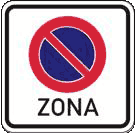
122.3. within the zone of operation of road sign No. 327 and, respectively on odd or even dates, within the zone of operation of road sign No. 328 or No. 329, and also on all roads in a territory where entry is marked with road sign No. 523;
327. 328.
328.  329.
329.  523.
523. 
122.4. in places where the edge of the carriageway or the kerb is marked with road marking No. 944, and also in places marked with road marking No. 945.
944. 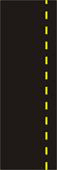 945.
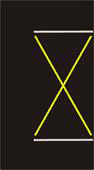
945. 
123. In the event of forced stopping in places where stopping or parking is prohibited, the vehicle driver shall do everything possible to clear the carriageway and move the vehicle to a place where stopping and parking is not prohibited.
12. Driving through Crossroads
124. When turning right or left, and, if flows of vehicles travelling in opposite directions are separated by a central reserve, also when making a U-turn, a vehicle driver must give way to pedestrians, cyclists and electric scooter riders crossing the carriageway into which he or she is turning.
125. It is prohibited to enter a crossroads or a place where carriageways intersect if congestion has formed that may force the vehicle driver to stop the vehicle in the crossroads or at the place where carriageways intersect and obstruct the movement of other vehicles.
12.1. Regulated Crossroads
126. When turning left or making a U-turn, where this is permitted by a traffic light signal, a vehicle driver must give way to drivers of vehicles travelling straight ahead in the opposite direction or turning right.
127. If signals of a traffic regulator or traffic light permit a tram and off-track vehicles to proceed at the same time, the tram has priority regardless of its direction of travel.
128. When driving in the direction indicated by an arrow that is illuminated in an additional section together with the red or yellow traffic light signal, a vehicle driver (including a tram driver) must give way to drivers of vehicles approaching from other directions.
129. A vehicle driver who has entered a crossroads when permitted by a traffic light signal must leave the crossroads in the intended direction regardless of the traffic light signal installed before the exit from the crossroads. If road sign No. 546 is installed in the crossroads before the traffic lights located in the vehicle driver's path of travel, the vehicle driver must observe the signals of each traffic light.
546.
130. When a permissive traffic light signal comes on, a vehicle driver must give way to drivers of vehicles that have entered the crossroads when permitted by a traffic light signal, as well as to pedestrians who have not managed to cross the carriageway.
131. If a traffic light is switched off or operates in flashing yellow mode, a vehicle driver must comply with the rules for crossing unregulated crossroads and the requirements of priority road signs installed before the crossroads.
12.2. Unregulated Crossroads
132. At a crossroads of roads of unequal priority, a vehicle driver driving on a minor road must give way to drivers of vehicles approaching the crossroads on the main road.
133. At a crossroads of roads of equal priority, a vehicle driver must give way to the driver of a vehicle approaching from the right.
134. At a crossroads of roads of equal priority, and also at a crossroads of roads of unequal priority where the vehicles are on roads of mutually equal priority, a tram driver has priority over drivers of off-track vehicles regardless of the tram's direction of travel.
135. If the main road changes direction at a crossroads, vehicle drivers travelling on the main road must mutually comply with the rules for crossing crossroads of roads of equal priority. These rules must also be mutually complied with by vehicle drivers travelling on a minor road.
136. When turning left or making a U-turn, drivers of off-track vehicles must give way to drivers of vehicles travelling straight ahead in the opposite direction on a road of equal priority or turning right. These rules must also be mutually complied with by tram drivers.
137. When a vehicle driver travelling on the main road turns left or makes a U-turn, he or she must give way to drivers of vehicles that have started overtaking.
138. If priority road signs have not been installed before a crossroads, and also if road sign No. 206 or No. 207 has not been installed on the road being crossed before the crossroads and the driver cannot determine whether the road has a surface (during the dark hours of the day or if the road is covered with mud, snow, etc.), the vehicle driver must consider that he or she is on a minor road.
206. 207.
13. Road Traffic in Living Zones
139. In a Living zone, at fuel stations and in parking areas, pedestrians and bicycle and electric scooter riders are allowed to move on footpaths and on the carriageway across its entire width.
140. In a Living zone and in the territory of fuel stations and parking areas, pedestrians and bicycle and electric scooter riders have priority, but they are prohibited from unjustifiably interfering with the movement of other vehicles.
141. Parking of vehicles in Living zones is allowed only in specially designated parking places. If such parking places do not exist or if they are occupied, parking of vehicles is allowed only in places where it does not interfere with the movement of pedestrians or other vehicles.
142. The following is prohibited in a Living zone:
142.1. (deleted by Cabinet Regulation No. 496 of 22.08.2017);
142.2. parking vehicles with the engine running for more than five minutes;
142.3. entry by lorries whose full mass exceeds 5 t, as well as by tractor machinery (except where this is necessary for loading or unloading cargo or performing work) and buses whose length exceeds 6 m (except where this is necessary for passengers to board or alight).
143. When leaving a Living zone, a vehicle driver must give way to other road traffic participants.
144. The requirements referred to in this Chapter also apply to the courtyards of multi-apartment buildings.
14. Pedestrian Crossings and Stops for Passenger Public Transport Vehicles
145. When approaching a non-regulated pedestrian crossing, a vehicle driver must reduce driving speed or stop the vehicle before the pedestrian crossing in order to give way to pedestrians who are crossing the carriageway on the pedestrian crossing or are stepping onto it, as well as to bicycle or electric scooter riders who are crossing the carriageway on the pedestrian crossing or are riding onto it, if they could be hindered or endangered.
146. If a vehicle has stopped before a non-regulated pedestrian crossing or other vehicles, when approaching a non-regulated pedestrian crossing, reduce their driving speed, a vehicle driver may continue driving only after having made sure that there are no pedestrians or bicycle or electric scooter riders in front of the vehicles.
147. In all cases (including outside pedestrian crossings), a vehicle driver must give way to blind pedestrians who signal with a white cane.
148. On a regulated pedestrian crossing and at crossroads, when a permissive traffic light signal is illuminated or a permissive signal is given by a traffic regulator, a vehicle driver must allow pedestrians and bicycle or electric scooter riders to complete crossing the carriageway.
149. It is prohibited to drive onto a pedestrian crossing if a traffic jam has formed beyond it that may force the vehicle driver to stop the vehicle on the crossing and hinder the movement of pedestrians or bicycle or electric scooter riders.
150. A vehicle driver must give way to pedestrians who are going to a passenger public transport vehicle stopped at a stop (in the middle of the road) in the same direction of travel or are coming from it.
151. When approaching a stopped vehicle fitted with a recognition sign for the carriage of a group of children, a vehicle driver must drive at such a speed that, if necessary, the vehicle can be stopped and children crossing the carriageway can be allowed to pass.
15. Crossing Level Crossings
152. When crossing a level crossing, a vehicle driver must give way to an approaching train (locomotive, draisine).
153. Before a level crossing, a vehicle driver must make sure that no train is approaching and must take into account the position of the barrier, light signalling, road signs and road markings, as well as the instructions and signals of the level crossing attendant. It is prohibited to drive if the level crossing attendant, standing with his or her chest or back towards the driver, signals with a baton raised above the head or with arms extended sideways.
154. It is prohibited to drive onto a level crossing if the barrier is closed or is starting to close, or if a prohibitory signal is lit in the traffic light (regardless of the position of the barrier, including if there is no barrier). If the traffic light is not operating or only a flashing white signal is lit, and the barrier is open or there is no barrier, a vehicle driver may drive across the level crossing only after making sure that no train is approaching.
155. In order to let an approaching train pass, as well as in other cases when crossing a level crossing is prohibited, a vehicle driver must stop the vehicle directly before the stop line (road marking No. 929), but if there is none, before road sign No. 546 or No. 207; if there are none, no less than 5 m before the barrier; if there is no barrier, no less than 10 m from the nearest railway track; if the level crossing is equipped only with a traffic light, before the traffic light. When starting to drive after stopping the vehicle, the vehicle driver must make sure once again that no train is approaching.
929. 546. 207.
156. It is prohibited to drive onto a level crossing if:
156.1. there is a traffic jam beyond it that may force the vehicle driver to stop the vehicle on the level crossing;
156.2. there is a stopped vehicle on it in the relevant driving direction. If there is a vehicle involved in an accident on the level crossing, the other drivers must do everything possible to clear the level crossing of it.
157. In the event of a forced stop on a level crossing, the vehicle driver must have passengers leave the vehicle and do everything possible to clear the level crossing. If it is not possible to drive the vehicle off the level crossing, the driver must, if possible, inform the rescue service and act as follows:
157.1. if possible, send people along the track in both directions (each 1000 m from the level crossing); if there is only one person, in the direction where the track is less visible, and explain how to give a stop signal to the train driver in order to stop the approaching train;
157.2. remain near the vehicle and give the general alarm signal;
157.3. when a train appears, run towards it, giving the stop signal. The stop signal is given by circling the arm, during the day while holding a brightly coloured cloth or another clearly visible object, and at night a lit torch or lantern. The general alarm signal is a series of sound signals consisting of one long and three short signals.
158. A vehicle driver is prohibited from:
158.1. transporting equipment and machinery that have not been prepared for transport (agricultural machinery, road construction machinery, construction machinery, etc.) across a level crossing;
158.2. crossing railway tracks in places not intended for that purpose;
158.3. bypassing vehicles stopped before a level crossing if movement across the level crossing is prohibited and the bypassing involves entering the side of the road intended for traffic in the opposite direction;
158.4. opening the barrier without authorisation or bypassing it.
159. With the permission of the head of the railway track maintenance section, the following vehicles may cross a level crossing:
159.1. vehicles whose dimensions, with or without a load, exceed 5 m in width or 4.5 m in height from the carriageway surface;
159.2. vehicles or vehicle combinations whose actual mass exceeds 52 t.
16. Use of External Lighting Devices
160. During daylight hours, motor vehicles and trams must be driven with daytime running lamps, dipped-beam headlights or front fog lamps switched on.
161. When driving during the hours of darkness, vehicles must have the following external lighting devices switched on:
161.1. for motor vehicles – dipped-beam or main-beam headlights, as well as position lamps and registration plate lighting;
161.2. for trailers – position lamps and registration plate lighting.
162. When driving in conditions of insufficient visibility, vehicles must have the following external lighting devices switched on:
162.1. for motor vehicles – dipped-beam headlights, main-beam headlights or front fog lamps, as well as position lamps and registration plate lighting;
162.2. for trailers – position lamps and registration plate lighting.
163. A vehicle driver must switch main-beam headlights to dipped-beam headlights:
163.1. in built-up areas, if the road is sufficiently and evenly lit;
163.2. at a distance of at least 150 m from an oncoming vehicle, or at a greater distance if the driver of the oncoming vehicle signals the need to switch headlights by periodically switching the headlight beam;
163.3. if other drivers may be dazzled (including those driving in the same direction). If a vehicle driver is dazzled, he or she must switch on the hazard warning lights and, without changing lanes, reduce the driving speed or stop the vehicle.
164. When stopping or parking on a road outside built-up areas during the hours of darkness or in conditions of insufficient visibility, motor vehicles and their trailers must have their position lamps switched on. In thick fog, heavy rain or snow, etc., it is also allowed to switch on dipped-beam headlights or front and rear fog lamps.
165. When stopping or parking in built-up areas on unlit road sections during the hours of darkness or in conditions of insufficient visibility, motor vehicles and their trailers must have their position lamps switched on, but motor vehicles without trailers are allowed to switch on parking lamps on the side facing the carriageway instead of position lamps. In thick fog, heavy rain or snow, etc., it is also allowed to switch on dipped-beam headlights or front and rear fog lamps.
166. When stopping or parking in built-up areas during the hours of darkness or in conditions of insufficient visibility, position lamps or parking lamps are allowed not to be switched on on road sections where the stopped vehicle is clearly visible to other drivers from a sufficient distance.
167. When driving, front fog lamps may be switched on:
167.1. in conditions of insufficient visibility – separately or together with dipped-beam headlights;
167.2. during the hours of darkness on unlit road sections – together with dipped-beam headlights.
168. Rear fog lamps may be switched on only in thick fog, heavy rain or snow, etc.
169. Searchlights and rotating beacons may be switched on only on vehicles that have been granted the status of emergency vehicles, provided that other vehicle drivers are not dazzled.
170. To attract the attention of other road traffic participants, headlight signals may be used as follows:
170.1. during daylight hours – by briefly switching on the main-beam headlights;
170.2. during the hours of darkness – by repeatedly and briefly switching the headlights (dipped-beam – main-beam), provided that other vehicle drivers are not dazzled.
171. The towed motor vehicle must have its hazard warning lights switched on at any time of day. If there are no hazard warning lights or they do not function, a warning triangle must be attached to the rear of the vehicle.
17. Use of the Audible Warning Signal, Hazard Warning Lights and Warning Triangle
172. An audible warning signal may be used only to prevent road traffic hazards, and outside built-up areas also to attract the attention of other road traffic participants.
173. The hazard warning lights shall be switched on (except where the motor vehicle is not equipped with them or they are not working) and a warning triangle shall be placed on the road in the following cases:
173.1. in the event of a forced stop in places where stopping or parking is prohibited, or in places where, due to visibility, weather conditions, the speed of other vehicles, the condition of the road surface, etc., the stopped vehicle may pose a threat to road traffic safety;
173.2. if a road traffic accident has occurred or a load has fallen or spilled onto the carriageway;
173.3. when stopping and parking on a road outside built-up areas during the hours of darkness or in conditions of insufficient visibility, if any of the front or rear position lamps is not lit.
174. When driving, the hazard warning lights shall also be switched on in the following cases:
174.1. if the driver of the vehicle is dazzled;
174.2. on a towed motor vehicle;
174.3. if the vehicle has any of the defects referred to in Paragraph 223 of these Regulations.
175. A warning triangle shall be placed on the road at such a distance from the vehicle as to warn other vehicle drivers of the danger in good time. In any case, the distance from the warning triangle to the vehicle shall be as follows:
175.1. in built-up areas — not less than 15 m;
175.2. outside built-up areas — not less than 100 m.
18. Towing of Vehicles
176. Motor vehicles may be towed:
176.1. using a flexible or rigid coupling;
176.2. by partially placing the motor vehicle to be towed on the towing vehicle (in the load platform or on a special support device).
177. When towing with a rigid or flexible coupling, there shall be a vehicle driver at the steering wheel of the motor vehicle being towed, except where the design of the rigid coupling ensures the controllability of the motor vehicle being towed.
178. The rigid coupling between the towing and towed motor vehicles shall ensure a distance not exceeding 4 m, while for a flexible coupling this distance shall be from 4 to 6 m. The flexible coupling shall be marked so that other road traffic participants can notice it in good time.
179. Tractor machinery with a gross mass exceeding 4000 kg may tow two trailers equipped with service brakes that ensure the functionality of the service brakes.
180. It is prohibited to tow:
180.1. more than one motor vehicle;
180.2. a motor vehicle with defective steering equipment (such a vehicle may be towed by partially placing it on the towing vehicle);
180.3. a motor vehicle with defective service brakes if its actual mass is greater than half the actual mass of the towing motor vehicle;
180.4. using a flexible coupling, if the service brake system of the motor vehicle being towed is defective or not working;
180.5. using a flexible coupling in black-ice conditions;
180.6. using a motorcycle without a sidecar, except where this has been provided for by the motorcycle manufacturer and the motorcycle without a sidecar is towing a trailer specially intended for that purpose;
180.7. a bicycle, an electric scooter or a two-wheeled moped, as well as a motorcycle without a sidecar;
180.8. more than one trailer, except in the case referred to in Paragraphs 179 and 179.1 of these Regulations;
180.9. a trailer whose mass exceeds the trailer mass intended for towing as specified by the manufacturer of the towing vehicle;
180.10. during the hours of darkness or in conditions of insufficient visibility — the technological aggregate — trailer referred to in Paragraph 182 of these Regulations;
180.11. a tractor-machinery trailer with a motor vehicle.
181. When towing with a flexible or rigid coupling, it is prohibited to carry passengers outside the cab in a towed lorry intended for special works whose van-type cargo compartment is fitted with passenger seats, as well as in a towed bus or trolleybus. If the towed motor vehicle is partially placed on the towing motor vehicle, passengers may be only in the cab of the towing motor vehicle.
182. Temporary movement of a technological aggregate — trailer (for example, a compressor, generator or builders’ accommodation trailer) on roads means towing it from one site to another, regardless of the distance, where it will be used for the intended works.
19. Carriage of Passengers
183. A vehicle shall not carry a greater number of passengers than indicated in the vehicle registration document or specified (provided for) by the vehicle manufacturer. Passengers, as well as domestic (indoor) animals, shall be carried in such a way that they do not interfere with the driver of the vehicle and do not restrict the driver’s visibility. Passengers in passenger cars and lorries may be carried only in seats intended for that purpose, but in buses also in standing places intended for that purpose.
184. When carrying groups of children travelling on excursions, to sports events, etc., there shall be at least one adult attendant on the bus. Such a vehicle shall have a distinguishing sign attached at the front and at the rear in accordance with the requirements referred to in Paragraph 233 of these Regulations.
185. If a child whose height does not exceed 150 cm is carried in a car whose seats are equipped with seat belts, the child shall be in a child seat or on a booster seat appropriate to the child’s age and weight, installed in accordance with the manufacturer’s instructions, and shall be fastened with a seat belt.
186. When carrying a person with a disability in a wheelchair, the person shall be fastened with a seat belt to a wheelchair secured in the vehicle.
187. It is prohibited to carry passengers in a lorry outside its cab. This prohibition does not apply to:
187.1. vehicles of structural units of the Ministry of the Interior and the National Armed Forces (the procedure for carrying passengers in such cases is determined by the internal regulatory enactments of the relevant institutions);
187.2. lorries intended for special works whose van-type cargo compartments are fitted with passenger seats and which are registered in accordance with the prescribed procedure.
188. In the cases referred to in Paragraph 187 of these Regulations, passengers may be carried by drivers who are entitled to drive vehicles corresponding to category C, but if the number of passengers (excluding the driver of the vehicle) exceeds eight persons, by drivers who are entitled to drive vehicles corresponding to category C and, respectively, category D1 or D.
189. It is prohibited to carry:
189.1. passengers outside the cab of tractor machinery, in a trailer (semi-trailer) and in the cargo compartment of a motorcycle;
189.2. children under three years of age in a car whose seats are not equipped with seat belts;
189.3. children whose height does not exceed 150 cm on the front seat of a car whose seats are not equipped with seat belts, as well as on a two-wheeled moped, motorcycle, tricycle, quadricycle or snowmobile, except where the child can keep balance and reach the footrests or is sitting in a seat appropriate to the child’s age and weight.
189.4. passengers on the rear seat of a car if a safety roll bar has been installed behind the front row of seats in accordance with the laws and regulations regarding the state technical inspection of vehicles and technical roadside inspection.
20. Carriage of Cargo
190. The mass of the cargo being carried and the distribution of load on the axles shall not exceed the values specified by the manufacturer of the relevant vehicle.
191. Cargo shall be placed in a vehicle and, where necessary, secured in accordance with the requirements laid down in the laws and regulations on the placement and securing of piece goods in road transport, so that the cargo:
191.1. does not endanger road traffic participants, fall off or drag along the road;
191.2. does not restrict the vehicle driver’s visibility;
191.3. does not affect the stability of the vehicle or make it more difficult to drive;
191.4. does not obscure external lighting devices, light reflectors, number plates and recognition signs, and does not prevent hand signals from being seen;
191.5. does not cause noise, raise dust, pollute or litter the environment.
192. It is allowed to carry cargo at the rear of a passenger car by using a rack specially intended for this purpose, which, with or without cargo, partly or completely obscures external lighting devices, light reflectors, the number plate or recognition signs, provided that the rack is equipped with duplicate external lighting devices, light reflectors and a number-plate mounting point with appropriate number-plate lighting.
193. Cargo must be marked in accordance with the requirements referred to in Paragraph 239 of this Regulation if:
193.1. at the front or rear it protrudes more than 1 m beyond the dimensions of the vehicle;
193.2. in width it protrudes more than 0.4 m beyond the outer edge of the front or rear marker lamps.
194. If the dimensions, with or without cargo, with or without removable equipment (for example, a loader), or the actual mass or axle load of lorries with a laden mass exceeding 3.5 t, buses and their trailers, as well as combinations of vehicles, exceed the values specified in Annex 2 to this Regulation, a permit to drive on roads must be obtained in accordance with the procedures laid down in the laws and regulations on oversized and heavy-weight transport.
194.1 Vehicles or combinations of vehicles may exceed the maximum lengths specified in Sub-paragraphs 1.1–1.9 of Annex 2 to this Regulation if they have cabs that improve their aerodynamic performance, energy efficiency and safety performance, or if, for energy-efficiency purposes, they are equipped with aerodynamic devices that are type-approved and comply with the laws and regulations on the conformity assessment of mopeds, motor vehicles, their trailers and components. Vehicles or combinations of vehicles equipped with such cabs or aerodynamic devices shall comply with Paragraph 4 of Annex 2 to this Regulation, and any exceeding of the maximum lengths shall not increase the cargo length of those vehicles or combinations of vehicles.
194.2 When using aerodynamic devices, the driver must comply with the following conditions:
194.2 1. in circumstances where the safety of other road traffic participants or the driver is endangered, the driver shall fold, retract or disconnect them;
194.2 2. when using them in urban and interurban road infrastructure, the driver shall take into account the specific characteristics of areas where the speed limit is 50 km/h or lower and where vulnerable road users are more likely to be present;
194.2 3. if they are used in intermodal transport operations specified in the Road Transport Law, and in particular where they are retracted or folded, they shall not exceed the maximum permitted length by more than 20 cm.
194.3 Vehicles powered by alternative fuels or zero-emission vehicles shall comply with the maximum permissible axle-load limits specified in Paragraphs 9, 10 and 11 of Annex 2 to this Regulation. The additional weight required for vehicles powered by alternative fuels or zero-emission vehicles shall be determined on the basis of documentation provided by the manufacturer when type approval is granted for the relevant vehicle. This additional weight shall be indicated in the certificate of conformity prepared in accordance with the laws and regulations on the conformity assessment of mopeds, motor vehicles, their trailers and components.
195. Police officers or customs officials may require the inspection of the dimensions, actual mass and axle loads of lorries, their trailers (semi-trailers) and buses.
21. Driving Training
196. A driving instructor at an educational institution must hold a driving licence for the corresponding category and an instructor’s certificate. A vehicle driver with at least three years’ driving experience in the corresponding category is allowed to provide individual driving instruction. Only one person may be trained individually in road traffic at the same time.
197. (Deleted by Cabinet Regulation No. 549 of 28.08.2018)
198. Driving training on roads may take place only in the presence of the trainer (vehicle driver) and only after the person being trained has sufficiently acquired driving skills. During driving training with a passenger car, bus or tractor machinery, the person being trained must be in the driver’s seat, and the trainer must be in the front passenger seat. The person being trained must know and comply with the requirements of this Regulation. The time periods and roads on which driving training is prohibited from 7.00 to 10.00 and from 16.00 to 20.00 shall be determined by the municipal council within its administrative territory.
199. Motor vehicles used for driving training must have a recognition sign in accordance with the requirements referred to in Paragraphs 235, 236 and 237 of this Regulation.
22. Additional Requirements for Cyclists
200. Cyclists shall ride on the bicycle lane, bicycle path or pedestrian and bicycle path for the relevant direction, as close as possible to its right edge. If there are none or they are located away from the road, cyclists are allowed:
200.1. to ride on the carriageway in a single file as close as possible to the right edge of the carriageway (driving lane). Cyclists may move farther into the carriageway in the following cases:
200.1.1. to bypass, pass or overtake;
200.1.2. to continue riding in the chosen direction in built-up areas where there are no more than two lanes for driving in one direction, if the far-right lane is arranged for a right turn;
200.1.3. when accompanying children under 12 years of age;
200.1.4. to ride across the full width of the driving lane, without unjustifiably hindering the movement of another vehicle, on roads where the permitted driving speed does not exceed 30 km/h, at a place where road works are not being carried out or there is no restriction with a specified operating time;
200.2. to ride on the shoulder, giving way to pedestrians;
200.3. to ride on a footpath if riding on the carriageway, taking into account road traffic intensity, road and meteorological conditions, is not possible, is difficult or is dangerous. When riding on a footpath, cyclists shall choose a riding speed that does not endanger or hinder pedestrians. If there is a risk that cyclists may endanger or hinder pedestrians, cyclists shall ride at a speed not exceeding pedestrian movement speed or shall stop the bicycle. Pedestrians moving on a footpath have priority. When riding on a footpath in places where cyclists’ riding trajectories intersect with the trajectories of other vehicles, cyclists shall assess the distance to approaching vehicles, assess their driving speed and make sure that it is safe.
201. Children under 12 years of age and the cyclists accompanying them may disregard the requirements referred to in Paragraph 200 of these Regulations regarding riding on a bicycle lane or carriageway, and they are allowed to ride on a footpath. When riding a bicycle, children under 12 years of age must wear a fastened protective helmet.
202. Cyclists shall ride at a speed that does not endanger road traffic safety. Cyclists are allowed to cross the carriageway along the imaginary continuation of a footpath or shoulder, as well as, without hindering pedestrians, on pedestrian crossings. Before crossing the carriageway, cyclists shall reduce their riding speed in good time and, if necessary for road traffic safety, stop the bicycle. When crossing the carriageway along the imaginary continuation of a footpath, cyclists shall ride at a speed not exceeding pedestrian movement speed and give way to vehicles travelling on the road being crossed.
203. At places where, outside crossroads, a bicycle path, pedestrian and bicycle path or common pedestrian and bicycle path crosses the carriageway and road traffic is not regulated, cyclists riding on these paths shall give way to vehicles travelling on the road being crossed.
204. Before turning left or making a U-turn at crossroads in built-up areas, a cyclist shall assess the type of road (one-way, two-way, number of lanes, permitted driving directions in them, etc.), traffic intensity and choose the safest way to perform the manoeuvre so as not to create situations dangerous to traffic:
204.1. at places where no bicycle path, pedestrian and bicycle path or common pedestrian and bicycle path has been arranged, the cyclist shall cross the place where carriageways intersect along the right edge of the carriageways, giving way to vehicles travelling straight ahead in the same direction and to those road traffic participants who have priority in accordance with the rules for driving at crossroads;
204.2. on roads where traffic moves in two directions and there is one lane in each direction, the left turn or U-turn shall be made in the manner referred to in Sub-paragraph 204.1 or from the far-left position taken on the carriageway;
204.3. if there are two lanes for driving in the relevant direction and a separate lane has been arranged for turning left, the left turn or U-turn shall be made in the manner referred to in Sub-paragraph 204.1 (except where the far-right lane is arranged for driving only to the right) or from the right edge of the far-left lane.
205. In built-up areas outside crossroads, a cyclist may turn left or make a U-turn from the right edge of the carriageway, but on roads where traffic moves in two directions with one lane in each direction, also from the far-left position taken in the driving lane for the relevant direction.
206. Outside built-up areas, a cyclist may turn left or make a U-turn only from the right edge of the carriageway (right shoulder), giving way to vehicles travelling in the same direction and to oncoming vehicles.
207. A bicycle must be in good technical condition. A bicycle must be equipped with brakes.
208. Bicycle trailers must have a red light reflector at the rear.
209. When riding during the dark hours of the day or in poor visibility conditions, a bicycle must be equipped with light reflectors on both sides, on both sides of its wheels; it must have a white reflector at the front and a red reflector at the rear, as well as a white light lamp lit at the front and a red light lamp lit at the rear. If there are no lamps or they do not work, the cyclist must wear a reflective vest or clothing with clearly visible elements of light-reflecting material.
210. Cyclists are prohibited from:
210.1. riding without holding the handlebars;
210.2. riding while holding on to another moving vehicle;
210.3. carrying cargo that hinders control or endangers other road traffic participants;
210.4. carrying passengers on a bicycle if it has not been specially manufactured for that purpose. Children up to seven years of age may be carried on a bicycle while wearing a fastened protective helmet, if additional seats and safe footrests for foot support have been installed;
210.5. towing other vehicles, except trailers manufactured specially for that purpose;
210.6. (deleted by Cabinet Regulation No. 56 of 16 January 2024);
210.7. riding on the carriageway intended for the opposite direction.
211. During training sessions or organised competitions, if cyclists are accompanied in the prescribed manner by specially equipped vehicles, they may disregard the requirements referred to in Paragraphs 200, 207, 208 and 209 of these Regulations, provided that road traffic safety is ensured.
22.1. Additional Requirements for Electric Scooter Riders
212.1 Electric scooter riders shall ride on the bicycle lane, bicycle path or pedestrian and bicycle path for the relevant direction, as close as possible to its right edge. If there are none, electric scooter riders are allowed:
212.1 1. to ride on the part of the carriageway marked with road marking No.956;
956. 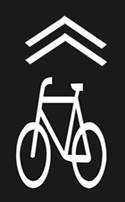
212.1 2. to ride on the shoulder, giving way to pedestrians;
212.1 3. to ride on a footpath or common pedestrian and bicycle path. When riding on a footpath or common pedestrian and bicycle path, electric scooter riders shall choose a riding speed that does not endanger or hinder pedestrians and, if necessary, shall ride at a speed not exceeding pedestrian movement speed. Electric scooter riders shall not endanger or hinder pedestrians. Pedestrians moving on a footpath have priority. When riding on a footpath or common pedestrian and bicycle path in places where the riding trajectories of electric scooter riders intersect with the trajectories of other vehicles, electric scooter riders shall assess the distance to approaching vehicles, assess their driving speed and make sure that it is safe;
212.1 4. to ride on the carriageway in a single file as close as possible to its right edge in places where the permitted driving speed does not exceed 50 km/h and where traffic is not heavy.
212.2 Electric scooter riders shall ride at a speed that does not endanger road traffic safety. Electric scooter riders are allowed to cross the carriageway along the imaginary continuation of a footpath or shoulder, as well as, without hindering pedestrians, on pedestrian crossings. Before crossing the carriageway, electric scooter riders shall reduce their riding speed in good time and, if necessary for road traffic safety, stop the electric scooter. When crossing the carriageway along the imaginary continuation of a footpath, electric scooter riders shall ride at a speed not exceeding pedestrian movement speed and give way to vehicles travelling on the road being crossed.
212.3 At places where, outside crossroads, a bicycle path, pedestrian and bicycle path or common pedestrian and bicycle path crosses the carriageway and road traffic is not regulated, electric scooter riders riding on these paths shall give way to vehicles travelling on the road being crossed.
212.4 When turning left or making a U-turn at crossroads in built-up areas where no bicycle path, pedestrian and bicycle path or common pedestrian and bicycle path has been arranged, an electric scooter rider shall cross the place where carriageways intersect along the right edge of the carriageway, giving way to vehicles travelling straight ahead in the same direction and to those road traffic participants who have priority in accordance with the rules for driving at crossroads.
212.5 An electric scooter shall be in good technical condition and equipped with brakes.
212.6 During riding, an electric scooter shall have a white light lamp lit at the front and a red light lamp lit at the rear. An electric scooter rider aged from 14 to 17 years shall wear a fastened protective helmet. If there are no lamps or they do not work, the electric scooter rider shall wear a reflective vest or clothing with clearly visible elements of light-reflecting material.
212.7 Electric scooter riders are prohibited from:
212.7 1. riding without holding the handlebars;
212.7 2. riding while holding on to another moving vehicle;
212.7 3. carrying cargo that hinders control or endangers other road traffic participants;
212.7 4. carrying a passenger;
212.7 5. riding on the carriageway intended for the opposite direction.
23. Additional Requirements for Drivers of Animal-Drawn Vehicles, Riders and Drovers
213. Persons who are at least 16 years old are allowed to drive an animal-drawn vehicle, ride or drive animals on roads. Persons aged 12 to 16 may assist in driving animals.
214. Driving an animal-drawn vehicle, riding and driving animals is allowed along the shoulder, but if there is no shoulder or it is not possible to move along it, along the carriageway as close as possible to the right edge of the carriageway. Animals may be driven along roads only during the light hours of the day.
215. When travelling on roads during the dark hours of the day or in conditions of poor visibility, an animal-drawn vehicle must have white light reflectors at the front and red light reflectors at the rear, placed in clearly visible locations and marking the width of the animal-drawn vehicle (with or without cargo). It is prohibited to cover the light reflectors.
216. When entering a priority road from a minor road in places where the road is not sufficiently visible or visibility is restricted (sharp bends in the road, trees, buildings, etc.), drivers of animal-drawn vehicles must lead the animals by the reins.
217. Drivers of animal-drawn vehicles and persons who drive animals or herds are prohibited from:
217.1. driving animals across a railway track bed and across a road outside specially indicated places;
217.2. leaving animals on the road unattended;
217.3. driving animals along roads with asphalt-concrete or cement-concrete surfacing, except where it is necessary to cross them;
217.4. driving an animal-drawn vehicle or driving a herd while under the influence of alcoholic beverages, narcotic, psychotropic or other intoxicating substances;
217.5. driving an animal-drawn vehicle or driving a herd while ill, under the influence of medication, or tired to such an extent that it affects the ability to drive the animal-drawn vehicle or herd safely, to perform the specified duties of a road user and may endanger other road users.
24. Technical Condition and Equipment of Vehicles
218. A bus, passenger car, lorry and motorcycle with a sidecar must be equipped with:
218.1. an emergency sign;
218.2. a first-aid kit (a bus with more than 25 seats must have two first-aid kits).
218.1 A lorry whose laden mass does not exceed 3.5 t and a passenger car must be equipped with one fire extinguisher whose extinguishing capacity class is 5A 21B or higher, while a lorry whose laden mass exceeds 3.5 t and a bus must be equipped with at least one fire extinguisher whose extinguishing capacity class is 27A 70B or higher.
219. During the period from 1 December to 1 March, a car and a bus whose laden mass does not exceed 3.5 t must be equipped with tyres intended for driving in winter conditions. During the period from 1 May to 1 October, it is prohibited to drive a vehicle fitted with studded tyres.
220. (Deleted by Cabinet Regulation No. 496 of 22 August 2017)
221. A moped must have the equipment, mechanisms and devices provided by the manufacturer installed, and they must operate in all intended modes. A moped must be equipped with two mutually independent brakes, a dipped-beam headlamp at the front, a red lamp and a red light reflector at the rear, a sound signal, a stand and a silencer. A moped manufactured after 1 January 2001 must additionally be equipped with a rear brake light, direction indicators, a number plate lighting lamp, rear-view mirrors and a speed measuring device (speedometer).
222. It is prohibited to drive a vehicle if it has any of the following defects:
222.1. during the dark hours of the day, both dipped-beam headlights do not light up;
222.2. in conditions of poor visibility, both dipped-beam headlights and, at the same time, both front fog lamps do not light up;
222.3. during rain or snow, the windscreen wiper on the vehicle driver’s side does not work;
222.4. defects in the steering system prevent the vehicle driver from performing a manoeuvre;
222.5. the service braking system does not allow the vehicle driver to stop the vehicle;
222.6. the coupling device of the towing vehicle and trailer (semi-trailer) has defects that may cause the coupling to break during driving;
222.7. dangerous defects that endanger road traffic safety have been detected for the vehicle during the state technical inspection or a technical roadside inspection;
222.8. the tyre tread depth is less than the minimum depth laid down in the laws and regulations regarding the state technical inspection of vehicles and technical roadside inspections.
223. If a vehicle has any of the following defects in external lighting devices, it may be driven to a parking place or repair site with the emergency light signalling switched on or with an emergency sign attached to the rear of the vehicle (only in the case of a defect in the rear external lighting devices):
223.1. none of the brake lights light up;
223.2. during the dark hours of the day or in conditions of poor visibility, none of the rear marker lamps or none of the number plate lighting lamps light up;
223.3. during the dark hours of the day, one of the dipped-beam headlights does not light up;
223.4. in conditions of poor visibility, one of the dipped-beam headlights and, at the same time, one of the front fog lamps does not light up.
224. If, on a road outside built-up areas, any of the front or rear marker lamps of a stopped motor vehicle or its trailer does not light up during the dark hours of the day or in conditions of poor visibility, the vehicle driver must do everything possible to move the vehicle off the road, but if this is not possible, it must be marked in accordance with the requirements referred to in Paragraph 175 of these Regulations.
225. It is prohibited to drive a vehicle equipped with:
225.1. objects, glass coatings, curtains, blinds, etc., that significantly restrict visibility for the vehicle driver in the driver’s direct field of vision. In relation to glass coatings, glass coatings that make the light transmission of the front glass (windscreen) less than 75 % or the light transmission of the front side windows (front door windows) less than 70 % are considered to significantly restrict visibility in the vehicle driver’s field of vision;
225.2. devices (anti-radar detectors, etc.) that can receive signals transmitted by driving speed control measuring devices or cause interference with the operation of such measuring devices;
225.3. devices (special blue or red flashing beacons, sound signal, roof light, light control signal, etc.) and special colour schemes which, in accordance with the requirements laid down in the laws and regulations regarding vehicle registration, are intended for emergency vehicles or, in accordance with the laws and regulations regarding passenger carriage by passenger taxis, are intended for taxis and may mislead other road users;
225.4. lighting devices that do not comply with the laws and regulations regarding the state technical inspection of vehicles and technical roadside inspections.
226. It is prohibited to alter the odometer data of a vehicle.
25. Vehicle Number Plates, Recognition Signs, Warning Devices and Markings
227. Number plates shall correspond to the registration documents of the relevant vehicle. Number plates must be clean; the characters on the number plate of a stationary vehicle must be legible in clear daylight from at least 40 m away, and in clear darkness, when the vehicle's external lighting devices are switched on, from at least 20 m away.
228. It is prohibited to drive if at least one of the number plates is not fixed in the intended place. It is prohibited to alter, cover, coat with protective materials, mechanically damage, bend or otherwise conceal a number plate.
229. Vehicle recognition signs (hereinafter – recognition signs), warning devices and markings shall be made in accordance with international agreements to which Latvia is a party or Annex 3 to these Regulations.
230. Recognition signs must be clean so that other road users can notice them in good time.
231. It is prohibited to attach to vehicles any other information or signs that use the road sign shapes, colour combinations and symbols specified in standard LVS 77-1:2016 "Road signs. Part 1: Road signs" and that may mislead other road users.
232. Vehicles permanently registered in Latvia that cross the national border must have a national distinguishing sign attached at the rear – a white ellipse 175 mm wide and 115 mm high with a black border 4 mm wide, 2 mm from the outer edge. The sign bears the black letters "LV", 60 mm high (Annex 3, Paragraph 1). The national distinguishing sign need not be attached if the vehicle's national registration number plates comply with the requirements specified for national registration number plates in the laws and regulations on vehicle registration.
233. When carrying groups of children, a yellow square recognition sign (side length from 250 to 300 mm) with a red border (border width – 1/10 of the side length) and the symbol of road sign No. 121 in black (Annex 3, Paragraph 2) must be attached to the front and rear of the bus.
121. 
234. (Deleted by Cabinet Regulation No. 219 of 28 May 2019)
235. Motor vehicles (including their trailers) used for driving training must have a recognition sign attached – a white equilateral triangle (side length from 200 to 300 mm, depending on the type of vehicle) with a red border (border width – 1/10 of the side length), bearing a black letter "M" (Annex 3, Paragraph 4).
236. The illuminated recognition sign referred to in Paragraph 235 of these Regulations must be placed on the roof of the cab or passenger compartment (on buses, an illuminated recognition sign may be placed behind the windscreen or in place of the route plate). Buses, lorries and their trailers, as well as trailers of tractor machinery, must have an additional recognition sign made of light-reflecting material attached at the rear.
237. On cars and tractor machinery used for individual driving training, the recognition sign referred to in Paragraph 235 of these Regulations may be attached to the front and rear window. Motorcycles must have a recognition sign made of light-reflecting material attached at the front and rear.
238. Vehicles carrying especially heavy or oversized loads, as well as vehicles whose manufacturer-specified maximum driving speed is lower than that specified in Paragraph 101 of these Regulations (except for the vehicles referred to in Paragraph 244 of these Regulations), must have a driving speed limit recognition sign attached (painted) on the rear left side of the vehicle – a coloured image of road sign No. 323 indicating the permitted driving speed (diameter from 160 to 250 mm, depending on the type of vehicle; border width – 1/10 of the diameter) (Annex 3, Paragraph 5).
323.
239. In the cases referred to in Paragraph 193 of these Regulations, a load or vehicle parts protruding beyond the vehicle dimensions must be marked during daylight hours with light-reflecting signal panels or flags (side length 400 mm) with white and red diagonal stripes 50 mm wide on both sides (Annex 3, Paragraph 6), and during darkness and in conditions of poor visibility – with the said light-reflecting signal panels or with switched-on lamps: white at the front, red at the rear, and orange (yellow) on the sides.
240. A vehicle carrying dangerous goods must have a recognition sign attached at the front and rear – an orange rectangle that complies with the requirements of the European Agreement concerning the International Carriage of Dangerous Goods by Road (ADR) (Annex 3, Paragraph 7).
241. Lorries with a laden mass exceeding 12 t (except lorries – tractor units) and articulated tourist buses must have one (horizontal) or two (horizontal or vertical), or four (two vertical and two horizontal) recognition signs attached at the rear – rectangles with slanting red fluorescent parallel stripes (at a 45° angle rising towards the vehicle axis) (Annex 3, Paragraph 8).
242. The recognition signs referred to in Paragraph 241 of these Regulations must be attached so that their lower edge is not lower than 250 mm and their upper edge is not higher than 2100 mm from the road surface. The total length of the recognition signs must be from 1130 to 2300 mm, their width from 130 to 150 mm, the width of the spaces between stripes must not exceed 100 mm, and the material between the stripes must be made of yellow light-reflecting material.
243. Trailers (semi-trailers) whose length, including the drawbar, exceeds 8 m, as well as trailers (semi-trailers) whose laden mass exceeds 10 t, must have recognition signs attached at the rear – yellow light-reflecting rectangles with a red fluorescent border (rectangle side width from 195 to 230 mm, border width 40 mm), the number, placement and total length of which comply with the requirements referred to in Paragraph 242 of these Regulations (Annex 3, Paragraph 9).
244. Motor vehicles whose manufacturer-specified maximum driving speed does not exceed 30 km/h, as well as their trailers, must have a recognition sign attached at the rear – a red fluorescent equilateral triangle with a light-reflecting yellow or red border (triangle side length from 350 to 365 mm, border width from 45 to 48 mm) (Annex 3, Paragraph 10).
245. Emergency sign – a red equilateral triangle made of light-reflecting material with a side length from 450 to 550 mm and a border width of at least 50 mm (Annex 3, Paragraph 11).
246. A parking card for persons with disabilities may be placed inside a car by the windscreen if the driver of the car or its passenger is a person to whom a parking card for persons with disabilities has been issued. The right to receive a parking card for persons with disabilities is held by:
246.1. a person with a disability who has mobility and gait impairments and to whom the State Medical Commission for the Assessment of Health Condition and Working Ability has issued an opinion on medical indications for special adaptation of a passenger car and for receipt of an allowance to compensate transport expenses;
246.2. a person with Group I visual disability;
246.3. a person under 18 years of age who has been determined to have a disability and to whom the State Medical Commission for the Assessment of Health Condition and Working Ability has issued an opinion on the need for special care.
246.1 The parking card for persons with disabilities is issued by the state joint stock company "Road Traffic Safety Directorate" on the basis of information provided electronically by the State Medical Commission for the Assessment of Health Condition and Working Ability regarding the person's right to receive a parking card for persons with disabilities, if an application from the recipient of the card or their representative has been received. The parking card for persons with disabilities is issued for the period for which the person has been granted disability corresponding to the conditions referred to in Paragraph 246 of these Regulations. If the determined disability period exceeds 10 years, the card is issued for 10 years. The fee for issuing the parking card for persons with disabilities is paid by the service recipient in accordance with the price list of the state joint stock company "Road Traffic Safety Directorate".
246.2 The parking card for persons with disabilities (Annex 3, Paragraph 12) is a dark-blue rectangle (length 148 mm, height 106 mm). On the left side of the obverse of the card, the validity period of the card, the issuer and the card series number are indicated; below this, the recognition sign of a person with a disability is shown in white. On the right side there is the Latvian distinguishing sign "LV"; below it, the inscription in Latvian "Eiropas Kopienas modelis"; below it, with spacing, the inscription in Latvian "Invalīdu stāvvietu izmantošanas karte"; below it, with spacing, an analogous inscription in other European Union languages. On the left side of the reverse of the card there is the card holder's photograph; below it, the person's given name, surname and signature are indicated. On the right side there is information in Latvian: "Šī karte pilnvaro tās īpašnieku izmantot speciāli apzīmētu stāvvietu pakalpojumus Eiropas Savienības dalībvalstīs."
26. Road Signs, Road Markings and Their Characteristics
247. Road signs (hereinafter – signs) (Annex 4) must comply with standard LVS 77–1:2016 "Road signs. Part 1: Road signs", LVS 77-2:2016 "Road signs. Part 2: Installation rules" and LVS 77-3:2016 "Road signs. Part 3: Technical requirements".
248. Variable message signs (signs in which the text and/or symbol information provided can be changed) must comply with standard LVS 77–1:2016 "Road signs. Part 1: Road signs", LVS 77-2:2016 "Road signs. Part 2: Installation rules" and LVS 77-3:2016 "Road signs. Part 3: Technical requirements".
249. If temporary signs placed, for example, on a movable stand, on a vehicle carrying out roadworks, or in another way indicating the temporary nature of their installation, have a different meaning from stationary signs, vehicle drivers must comply with the requirements of the temporary signs. For equipping work sites on roads, the white background of temporary signs may be replaced with yellow.
26.1. Warning Signs
250. Warning signs warn vehicle drivers of approaching a dangerous road section. While driving along this section, a vehicle driver must act according to the circumstances. Warning signs are the following:
250.1. sign No. 101 "Crossroads with priority to the right";
101. 
250.2. sign No. 102 "Roundabout";
102. 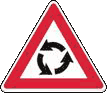
250.3. signs No. 103 and No. 104 "Single Curve". A bend (sign No. 103 - to the right; sign No. 104 - to the left) with a small radius or curve the visibility of which is obstructed by buildings, plantings and similar obstacles;
103. 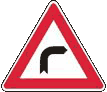 104.
104. 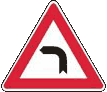
250.4. signs No. 105 and No. 106 "Double Curve". Road section with dangerous bends (sign No. 105 - first curve to the right; sign No. 106 - first curve to the left);
105. 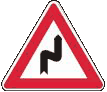 106.
106. 
250.5. signs No. 107, No. 108 and No. 109 "Road narrows" (sign No. 107 - from both sides; sign No. 108 - from the right side; sign No. 109 - from the left side);
107.  108.
108.  109.
109. 
250.6. sign No. 110 "Steep descent";
110.
250.7. sign No. 111 "Steep ascent";
111.
250.8. sign No. 112 "Uneven road ahead". Road section where the carriageway surface is uneven (waves, potholes, uneven points of the road and bridge joints and similar);
112. 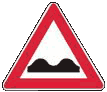
250.9. sign No. 113 "Speed bump". Road section where artificial raised areas have been created on the carriageway to reduce driving speed;
113. 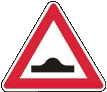
250.10. sign No. 114 "Change of road surface". Road section where asphalt-concrete or cement-concrete surface changes to gravel surface and vice versa;
114. 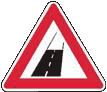
250.11. sign No. 115 "Slippery road surface";
115. 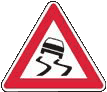
250.12. sign No. 116 "Loose gravel or crushed stone". Road section where gravel, broken stones and similar materials may be thrown from under the wheels;
116. 
250.13. sign No. 117 "Falling rocks". Road section where landslides, landslips, falling stones may occur;
117. 
250.14. sign No. 118 "Roadworks". Road section where any works which take up the road or affect traffic conditions are carried out on the road, next to it or above it;
118. 
250.15. sign No. 119 "Road with dangerous shoulders";
119. 
250.16. sign No. 120 "Pedestrian crossing". Approaching a pedestrian crossing marked with signs No. 535 and No. 536 where drivers must give way to pedestrians;
120. 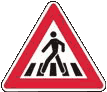 535. 536.
250.17. sign No. 121 "Children". Road section where children may suddenly appear on the carriageway;
121.
250.18. sign No. 122 "Two-way traffic". The beginning of the road (carriageway) section where traffic is organised in both directions;
122. 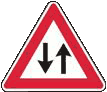
250.19. sign No. 123 "Traffic lights". Intersection, pedestrian crossing or road section where road traffic is regulated by traffic lights;
123. 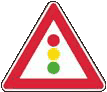
250.20. sign No. 124 "Domestic animals";
124. 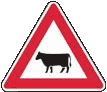
250.21. sign No. 125 "Wild animals";
125. 
250.22. sign No. 126 "Opening bridge". Opening bridge or ferry link;
126. 
250.23. sign No. 127 "Quayside". The place where the road leads to quayside or the bank of a body of water;
127. 
250.24. sign No. 128 "Dangerous crosswinds";
128. 
250.25. sign No. 129 "Low-flying aircraft";
129. 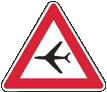
250.26. sign No. 130 "Bicycle path crossing". The place where the road is crossed by a bicycle path, pedestrian and bicycle path, combined pedestrian and bicycle path, bicycle lane or bicycles and electric scooters may often enter the road;
130. 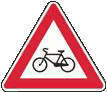
250.27. sign No. 131 "Tram track crossing";
131. 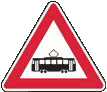
250.28. sign No. 132 "Level crossing with barriers";
132. 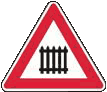
250.29. sign No. 133 "Level crossing without barriers";
133. 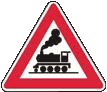
250.30. sign No. 134 "Single-track level crossing". A level crossing with one track where a barrier has not been installed;
134.
250.31. sign No. 135 "Multi-track level crossing". Level crossing with two or several tracks where a barrier has not been installed;
135.
250.32. signs No. 136, No. 137, No. 138, No. 139, No. 140 and No. 141 "Approaching a level crossing". Additional warning of approaching a level crossing outside built-up areas;
136.  137.
137.  138.
138.  139.
139.  140.
140.  141.
141. 
250.33. sign No. 142 "Dangerous". Dangerous road section where the danger cannot be indicated by other warning signs;
142. 
250.34. sign No. 143 "Traffic jam".
143. 
251. Outside built-up areas signs No. 101, 102, 103, 104, 105, 106, 107, 108, 109, 110, 111, 112, 113, 114, 115, 116, 117, 118, 119, 120, 121, 122, 123, 124, 125, 126, 127, 128, 129, 130, 131, 132, 133, 142 and 143 shall be installed 150–200 m before the dangerous road section, but in built-up areas – 50–60 m before it. Where necessary, the signs shall be installed at another distance, indicated by sign No. 801.
101. 102. 103. 104.105. 106. 107. 108. 109. 110. 111. 112. 113. 114. 115. 116. 117. 118. 119. 120. 121. 122. 123. 124. 125. 126. 127. 128. 129. 130. 131. 132. 133. 142. 143. 801. 
252. Outside built-up areas, signs No. 118, No. 121, No. 126, No. 127, No. 132 and No. 133 shall be installed repeatedly. The second sign shall be installed at least 50 m before the beginning of the dangerous section.
118. 121. 126. 127. 132. 133.
253. In restricted conditions and in a built-up area, the second sign No. 118 may be installed directly at the beginning of the roadworks site. If the roadworks are temporary, sign No. 118 (without sign No. 801) may be installed 10–15 m before the roadworks site.
118. 801.
254. Sign No. 113 need not be installed in Living zones or in places where the maximum permitted driving speed does not exceed 30 km/h.
113.
255. Signs No. 134 and No. 135 shall be installed directly before the level crossing.
134. 135.
256. If steep downhill or uphill sections follow one another, sign No. 110 or No. 111 may be installed before the beginning of the second or following downhill or uphill section at a distance indicated by additional sign No. 801.
110. 111. 801.
257. Signs No. 136, No. 138 and No. 140 shall be installed on the right side of the road, and signs No. 137, No. 139 and No. 141 on the left side. Signs No. 136 and No. 137 shall be installed together with the first sign No. 132 or No. 133 in the driving direction; signs No. 140 and No. 141 – with the second sign No. 132 or No. 133. Signs No. 138 and No. 139 shall be installed separately, at an equal distance between the first and second sign No. 132 or the first and second sign No. 133.
136. 138. 140. 137. 139. 141. 132. 133.
26.2. Priority Signs
258. Priority signs indicate the order of driving in unregulated intersections, places where carriageways intersect or narrow road sections. Priority signs are the following:
258.1. sign No. 201 "Priority road". A road on which drivers have priority when crossing unregulated intersections;
201.
258.2. sign No. 202 "End of priority road";
202.
258.3. signs No. 203, No. 204 and No. 205 "Crossroads with a minor road" (sign No. 203 - from both sides; sign No. 204 - from the right side; sign No. 205 - from the left side). One sign may show two mutually close intersections, and the distance between them is not indicated. These signs shall be placed at a distance of 150-200 m from the crossroads outside built-up areas;
203. 204. 205.
258.4. sign No. 206 "Give way". A vehicle driver must give way to vehicles travelling on the road to be crossed, but, if sign No. 847 is additionally installed - the driver must give way to vehicles driving along the priority road, and also to vehicles approaching from the right on a road of equal priority, except for tram drivers who have priority in this case in accordance with Paragraph 134 of these Regulations in this case;
206. 847. 
258.5. sign No. 207 "Stop and give way". It is prohibited to proceed without stopping directly before the stop line (road marking No. 929), but, if there is none - directly before the edge of the carriageway to be crossed. A vehicle driver must give way to vehicles travelling on the road to be crossed, but, if sign No. 847 is additionally installed - the driver must give way to vehicles driving along the priority road, and also to vehicles approaching from the right on a road of equal priority, except for tram drivers who have priority in this case in accordance with Paragraph 134 of these Regulations in this case. Sign 207 may be placed also before an unguarded level crossing, and also before a special quarantine post, a border crossing point and other places where road traffic is stopped by a barrier or otherwise. In this case the vehicle driver must stop the vehicle directly before the stop line (road marking No. 929), but if there is none – directly before the sign;
207. 929. 847.
258.6. sign No. 208 "Give way to oncoming traffic". It is prohibited to drive into the narrowed section of the road, if it may hinder oncoming traffic. A vehicle driver must give way to oncoming vehicles that are in the narrowed section of the road or at the opposite end of this section;
208. 
258.7. sign No. 209 "Priority over oncoming traffic". Narrow section of the road driving along which a vehicle driver has priority over oncoming vehicles.
209. 
26.3. Prohibitory Signs
259. Prohibitory signs establish or revoke specific road traffic restrictions. Prohibitory signs are as follows:
259.1. 301. road sign "No entry". Entry is prohibited for all vehicles;
301.
259.2. 302. road sign "No vehicles". Driving is prohibited for all vehicles;
302.
259.3. 303. road sign "No motor vehicles";
303.
259.4. 304. road sign "No motorcycles". Driving is prohibited for two-wheeled mopeds, motorcycles, tricycles and quadricycles;
304.
259.5. 305. road sign "No bicycles". Riding bicycles and electric scooters is prohibited;
305.
259.6. 306. road sign "No lorries". Driving is prohibited for lorries and combinations of lorries whose maximum authorised mass exceeds 3.5 t (if the maximum authorised mass is not indicated on the sign) or whose maximum authorised mass exceeds the mass indicated on the sign, as well as for tractor machinery;
306.
259.7. 307. road sign "No vehicles with trailers". Driving is prohibited for lorries and tractor machinery with any type of trailer, as well as towing a motor vehicle;
307. 
259.8. 308. road sign "No tractors". Driving is prohibited for tractor machinery;
308.
259.9. 309. road sign "No pedestrians";
309.
259.10. 310. road sign "Width limit". Driving is prohibited for vehicles whose overall width (with or without load) exceeds the width indicated on the sign;
310.
259.11. 311. road sign "Height limit". Driving is prohibited for vehicles whose overall height (with or without load) from the surface of the carriageway exceeds the height indicated on the sign;
311.
259.12. 312. road sign "Weight limit". Driving is prohibited for vehicles (combinations of vehicles) whose actual total mass exceeds the mass indicated on the sign;
312.
259.13. 313. road sign "Axle load limit". Driving is prohibited for vehicles whose actual load on any axle exceeds the load indicated on the sign;
313.
259.14. 314. road sign "Length limit". Driving is prohibited for vehicles (combinations of vehicles) whose overall length (with or without load) exceeds the length indicated on the sign;
314. 
259.15. 315. road sign "No right turn";
315.
259.16. 316. road sign "No left turn";
316.
259.17. 317. road sign "No U-turn";
317. 
259.18. 318. road sign "Minimum distance limit". The distance between moving vehicles must not be less than that indicated on the sign;
318.
259.19. 319. road sign "No overtaking". It is prohibited to overtake any vehicles, except single vehicles and combinations of vehicles travelling at a speed of less than 30 km/h;
319.
259.20. 320. road sign "End of overtaking prohibition";
320.
259.21. 321. road sign "No overtaking by lorries". Lorries and combinations of lorries whose maximum authorised mass exceeds 3.5 t are prohibited from overtaking any vehicles, except single vehicles and combinations of vehicles travelling at a speed of less than 30 km/h. Tractor machinery is prohibited from overtaking any vehicles, except horse-drawn vehicles and bicycles;
321.
259.22. 322. road sign "End of overtaking prohibition for lorries";
322.
259.23. 323. road sign "Maximum speed limit". It is prohibited to drive at a speed (km/h) exceeding that indicated on the sign;
323.
259.24. 324. road sign "End of maximum speed limit";
324.
259.25. 325. road sign "Use of audible warning signals prohibited";
325.
259.26. 326. road sign "No stopping". Vehicles are prohibited from stopping and parking;
326.
259.27. 327. road sign "No parking". Vehicles are prohibited from parking;
327.
259.28. 328. road sign "No parking on odd dates";
328.
259.29. 329. road sign "No parking on even dates";
329.
259.30. 330. road sign "End of all restrictions". It simultaneously indicates the end of the area of effect of signs 318, 319, 321, 323, 325, 326, 327, 328 and 329;
330.  318. 319. 321. 323. 325. 326. 327. 328. 329.
259.31. 331. road sign "Customs". It is prohibited to drive further without stopping the vehicle immediately before the sign. Permission to drive further is given by a customs (control point) official;
331.
259.32. 332. road sign "Police". It is prohibited to drive further without stopping the vehicle immediately before the sign. Permission to drive further is given by a police officer or border guard (at the state border);
332. 
259.33. 333. road sign "Driving further is dangerous". It is prohibited for all vehicles (without exception) to drive further due to a road traffic accident, emergency or similar reasons;
333. 
259.34. 334. road sign "No vehicles carrying dangerous goods".
334. 
260. If signs 328 and 329 are installed respectively on one side and the other side of the road, then between 21.00 and 24.00 vehicles which will be prohibited from parking on the respective side of the road the following day must be moved to the other side of the road.
328. 329.
261. The area of effect of signs 301, 302, 303, 315, 316 and 317 does not apply to passenger public transport vehicles.
301. 302. 303. 315. 316. 317.
262. The area of effect of signs 302, 303, 304, 306, 307 and 308 does not apply to vehicles which deliver or are travelling to collect goods, or to special vehicles (for example, truck-mounted cranes) travelling to carry out work in the area marked with any of these road signs. The area of effect of signs 302 and 303 also does not apply to bicycles, electric scooters, mopeds, motorcycles, tricycles and quadricycles, passenger cars and lorries whose maximum authorised mass does not exceed 3.5 t and whose owner (holder) lives or works in this area, or to taxis travelling to pick up a passenger or with a passenger, while the area of effect of signs 304 and 305 also does not apply to the owners (holders) of those vehicles who live or work in this area. The area of effect of sign 306 also does not apply to vehicles used for a driving skills test in accordance with the procedures laid down in laws and regulations.
302. 303. 304. 306. 307. 308. 305.
263. The area of effect of signs 302, 303 and 327 does not apply to cars marked with a disabled parking permit card.
302. 303. 327.
264. The area of effect of signs 312 and 313 does not apply to vehicles for which, after assessing public safety and danger, a permit has been issued by the state limited liability company "Latvijas Valsts ceļi" to carry out special transport operations (for example, to transport animal by-products and derived products not intended for human consumption).
312. 313.
265. The area of effect of signs 315 and 316 applies to the place where the carriageways intersect before which the sign has been installed.
315. 316.
266. In the area of effect of sign 326, the following is permitted:
326.
266.1. passengers getting into or out of taxis – passenger cars;
266.2. taxis – passenger cars – stopping with the meter switched on, with the taxi driver remaining in the vehicle;
266.3. persons with disabilities getting into or out of vehicles marked with a disabled parking permit card;
266.4. passengers getting into and out of passenger public transport vehicles at their stops;
266.5. taxis – passenger cars – parking in a parking place marked with sign 543;
543.
266.6. loading animal by-products and derived products not intended for human consumption into vehicles.
267. Local governments are entitled, by adopting a relevant decision, to determine the period during which goods may be loaded into or unloaded from vehicles in the area of effect of signs 326, 327, 328 and 329.
326. 327. 328. 329.
268. The area of effect of signs 309, 326, 327, 328 and 329 applies only to the side of the carriageway on which the sign is installed.
309. 326. 327. 328. 329.
269. The area of effect of signs 318, 319, 321, 323, 325, 326, 327, 328 and 329 is valid from the place where the sign is installed to the nearest junction beyond the sign, but if there is no junction – to sign 520 or 556. If sign 323 is installed before a built-up area, the area of effect of the mentioned sign is valid from the place where it is installed to sign 519 or 555. The area of effect of the signs does not end at places where vehicles enter the road from adjacent territory (a yard, parking place, fuel filling station, undertaking, etc.), or at places where the road is crossed by, or branches into, a country road, forest road or another similar road before which the relevant priority signs have not been installed, or at junctions which have no direct connection to the relevant carriageway.
318. 319. 321. 323. 325. 326. 327. 328. 329. 520. 556. 519. 555.
270. The area of effect of signs may be reduced:
270.1. for signs 318, 319, 321, 323, 325, 326, 327, 328 and 329 – by installing sign 330 or 803;
318. 319. 321. 323. 325. 326. 327. 328. 329. 330. 803. 
270.2. for signs 319, 321 and 323 – by installing sign 320, 322 or 324 respectively;
319. 321. 323. 320. 322. 324.
270.3. for sign 323 – by installing sign 323 with a different maximum speed limit;
323.
270.4. for signs 326, 327, 328 and 329 – by repeatedly installing sign 326, 327, 328 or 329 together with sign 810 in the area of effect. Sign 326 may be used together with road marking 943, but sign 327 – with road marking 944. In such cases, the area of effect of the signs is determined by the length of the road marking line. The area of effect of signs 326, 327, 328 and 329 ends at the place where a parking place arranged on the carriageway or partly on it and marked with sign 529, 537 or 539 begins.
326. 327. 328. 329. 810.  943. 944. 529. 537. 539.
26.4. Mandatory Signs
271. Mandatory signs are as follows:
271.1. sign No. 401 "Proceed straight";
401.
271.2. sign No. 402 "Proceed right";
402. 
271.3. sign No. 403 "Proceed left";
403.
271.4. sign No. 404 "Proceed straight or right";
404. 
271.5. sign No. 405 "Proceed straight or left";
405. 
271.6. sign No. 406 "Proceed right or left";
406.
271.7. sign No. 407 "Proceed right";
407. 
271.8. sign No. 408 "Proceed left";
408.
271.9. sign No. 409 "Roundabout";
409.
271.10. sign No. 410 "Pass the obstacle on the right";
410. 
271.11. sign No. 411 "Pass the obstacle on the left";
411.
271.12. sign No. 412 "Pass the obstacle on either side";
412.
271.13. sign No. 413 "Bicycle path". It is permitted to ride only bicycles and electric scooters, and, if the sign is not used to mark a bicycle lane, pedestrians are also permitted to move using the sports or recreational equipment referred to in Paragraph 8 of these Regulations, provided that bicycle and electric scooter traffic is not hindered;
413.
271.14. sign No. 414 "End of bicycle path";
414.
271.15. sign No. 415 "Pedestrian path". It is permitted for pedestrians only;
415.
271.16. sign No. 416 "End of pedestrian path";
416.
271.17. sign No. 417 "Shared pedestrian and bicycle path". It is permitted to ride only bicycles and electric scooters, and pedestrians are also permitted to move. Bicycle and electric scooter riders and pedestrians must act so that they do not endanger or hinder one another. Pedestrians must take into account the presence of bicycles and electric scooters on this path, while bicycle and electric scooter riders must, if necessary, travel at a speed not exceeding pedestrian movement speed;
417.
271.18. sign No. 418 "End of shared pedestrian and bicycle path";
418.
271.19. signs No. 419 and 421 "Pedestrian and bicycle path". On one side of the pedestrian and bicycle path it is permitted to ride only bicycles and electric scooters, while on the other side pedestrians may move (as indicated on the sign);
419. 421.
271.20. signs No. 420 and 422 "End of pedestrian and bicycle path";
420. 422.
422. 
271.21. sign No. 423 "Minimum speed limit". It is permitted to drive at a speed (km/h) not lower than that indicated on the sign;
423.
271.22. sign No. 424 "End of minimum speed limit";
424.
271.23. sign No. 425 "Vehicles carrying dangerous goods must proceed straight";
425. 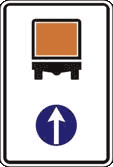
271.24. sign No. 426 "Vehicles carrying dangerous goods must proceed right";
426. 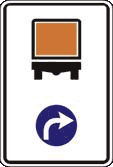
271.25. sign No. 427 "Vehicles carrying dangerous goods must proceed left".
427. 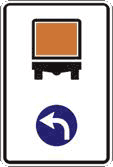
272. Signs No. 401, 402, 403, 404, 405, 406, 407, 408 and 409 indicate that driving is permitted only in the directions shown on the sign. Signs that permit a left turn also permit making a U-turn (signs No. 401, 402, 403, 404, 405, 406, 407 and 408 may be used with an arrow configuration corresponding to the permitted directions of travel at the junction).
401. 402. 403. 404. 405. 406. 407. 408. 409.
273. Signs No. 401, 402, 403, 404, 405 and 406 do not apply to passenger public transport vehicles. Signs No. 401, 402, 403, 404, 405, 406, 425, 426 and 427 apply to the carriageway crossing before which the sign is placed.
401. 402. 403. 404. 405. 406. 425. 426. 427.
274. If sign No. 401 is placed at the beginning of a road section, its area of effect extends to the nearest junction after the sign or to the end of the built-up area. The sign does not prohibit turning right to enter courtyards and other adjacent territories.
401.
275. Signs No. 407 and 408 indicate that the turn must be made before this sign.
407. 408.
26.5. Information Signs
276. Information signs introduce or cancel a specific road traffic regime. Information signs are as follows:
276.1. sign No. 501 "One-way road". A road or carriageway on which vehicles are permitted to travel in one direction over its full width;
501. 
276.2. sign No. 502 "End of one-way road";
502. 
276.3. signs No. 503 and 504 "Exit onto a one-way road". Exit onto a road or carriageway on which driving is permitted in one direction — the direction indicated on the sign;
503.  504.
504. 
276.4. sign No. 505 "Lane for passenger public transport vehicles". A lane intended only for passenger public transport vehicles, taxis and electric vehicles travelling in the same direction as the rest of the vehicle flow, and, if this sign is installed together with additional sign No. 824, also for bicycles and electric scooters. The sign applies to the lane above which it is installed. If the sign is installed on the right side of the road, it applies to the right traffic lane. The sign is in force from the place where it is installed to the nearest junction after the sign, but, if there is no junction, to sign No. 506;
505. 824. 506. 
276.5. sign No. 506 "End of lane for passenger public transport vehicles";
506.
276.6. sign No. 507 "Road with a lane for passenger public transport vehicles". A road on which passenger public transport vehicles, taxis and electric vehicles, and, if this sign is installed together with additional sign No. 824, also bicycles and electric scooters, move in a separate lane against the flow of other vehicles;
507. 824.
276.7. sign No. 508 "End of road with a lane for passenger public transport vehicles";
508. 
276.8. signs No. 509 and 510 "Exit onto a road with a lane for passenger public transport vehicles";
509. 510.
276.9. sign No. 511 "Minimum driving speed limit by lanes". The number of lanes and the minimum driving speed limit for each lane;
511. 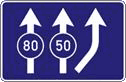
276.10. sign No. 512 "Maximum driving speed limit by lanes". The number of lanes and the maximum driving speed limit for each lane;
512. 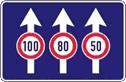
276.11. sign No. 513 "Directions of travel by lanes". The number of lanes and the directions of travel from them at a junction. Information on road traffic restrictions at the junction may be indicated on sign No. 513. Sign No. 513 that permits turning left from the leftmost traffic lane also permits making a U-turn from that lane. Sign No. 513 applies to the entire junction before which the sign is installed, unless another sign No. 513, 514, 515, 516, 517 or 518 installed at the junction gives other instructions;
513. 514. 515. 516. 517. 518. 
276.12. signs No. 514, 515 and 516 "Direction of travel in a lane". The direction of travel from the lane at a junction. Information on road traffic restrictions at the junction may be indicated on signs No. 514, 515 and 516. Sign No. 516 permits turning left from the leftmost traffic lane and also permits making a U-turn from that lane (signs No. 514, 515 and 516 may be used with an arrow configuration corresponding to the permitted directions of travel at the junction). Signs No. 514, 515 and 516 apply to the entire junction before which the sign is installed, unless another sign No. 513, 514, 515, 516, 517 or 518 installed at the junction gives other instructions;
514. 515. 516. 513. 517. 518.
276.13. signs No. 517 and 518 "Directions of travel in a lane". The directions of travel from the lane at a junction. Information on road traffic restrictions at the junction may be indicated on signs No. 517 and 518. Sign No. 518 that permits turning left from the leftmost traffic lane also permits making a U-turn from that lane (signs No. 517 and 518 may be used with an arrow configuration corresponding to the permitted directions of travel at the junction). Signs No. 517 and 518 apply to the entire junction before which the sign is installed, unless another sign No. 513, 514, 515, 516, 517 or 518 installed at the junction gives other instructions;
517. 518. 513. 514. 515. 516.
276.14. sign No. 519 "Start of a built-up area". A place in a city or village from which the requirements of these Regulations governing road traffic in built-up areas apply;
519.
276.15. sign No. 520 "End of a built-up area". The end of the built-up area indicated by sign No. 519;
520. 519.
276.16. sign No. 521 "Name of a city or village". The sign indicates the boundary (beginning) of a city or village;
521. 
276.17. sign No. 522 "Name of a city or village". The sign indicates the boundary (end) of a city or village;
522. 
276.18. sign No. 523 "No-parking zone". Parking is prohibited on all roads in the territory where entry is marked with sign No. 523. The sign does not apply to cars marked with a parking card for persons with disabilities;
523.
276.19. sign No. 524 "End of no-parking zone";
524. 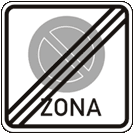
276.20. sign No. 525 "Maximum speed limit zone". A maximum speed limit on all roads in the territory where entry is marked with sign No. 525;
525. 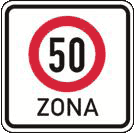
276.21. sign No. 526 "End of maximum speed limit zone";
526. 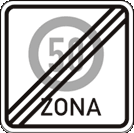
276.22. sign No. 527 "Pedestrian path zone". Pedestrian paths — movement is permitted only for pedestrians;
527. 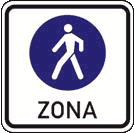
276.23. sign No. 528 "End of pedestrian path zone";
528. 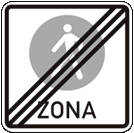
276.24. sign No. 529 "Parking zone". A zone in which uniform vehicle positioning is indicated by an additional sign;
529.
276.25. sign No. 530 "End of parking zone";
530. 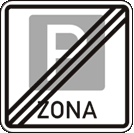
276.26. sign No. 531 "Recommended speed zone". A zone in which it is recommended to drive at the speed indicated on the sign;
531. 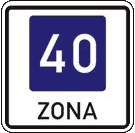
276.27. sign No. 532 "End of recommended speed zone";
532. 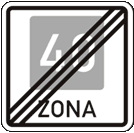
276.28. sign No. 533 "Residential zone". A place from which the requirements of these Regulations governing road traffic in residential zones apply;
533.
276.29. sign No. 534 "End of residential zone";
534.
276.30. sign No. 535 "Pedestrian crossing". The sign is installed on the right side of the road at the nearest boundary of the crossing;
535.
276.31. sign No. 536 "Pedestrian crossing". The sign is installed on the left side of the road at the farthest boundary of the crossing;
536.
276.32. sign No. 537 "Parking place". The sign is in force from the place where it is installed to the nearest junction after the sign, but, if there is no junction, to sign No. 538, 520, 556, 326, 327, 328 or 329. In the lower part of the sign, the direction in which to travel to a parking place located in the immediate vicinity of the road may be indicated. A building roof symbol indicates an underground or above-ground multi-storey car park. The prohibitions referred to in Sub-paragraphs 121.6 and 122.1 of these Regulations do not apply in the parking place;
537. 538.  520. 556. 326. 327. 328. 329.
276.33. sign No. 538 "End of parking place";
538.
276.34. sign No. 539 "Paid parking place". The sign is in force from the place where it is installed to the nearest junction after the sign, but, if there is no junction, to sign No. 540, 520, 556, 326, 327, 328 or 329. The sign may indicate the maximum parking duration that may be paid for immediately. In the lower part of the sign, the direction in which to travel to a parking place located in the immediate vicinity of the road may be indicated. The prohibitions referred to in Sub-paragraphs 121.6 and 122.1 of these Regulations do not apply in the parking place;
539. 540.  520. 556. 326.327. 328. 329.
276.35. sign No. 540 "End of paid parking place";
540.
276.36. sign No. 541 "Bus and trolleybus stop";
541.
276.37. sign No. 542 "Tram stop";
542.
276.38. sign No. 543 "Taxi stand";
543.
276.39. sign No. 544 "Tunnel";
544. 
276.40. sign No. 545 "End of tunnel";
545. 
276.41. sign No. 546 "Stopping place". The place where a vehicle must be stopped if driving is prohibited by a traffic light signal or a signal from a traffic controller;
546.
276.42. sign No. 547 "Start of border area";
547. 
276.43. sign No. 548 "End of border area";
548. 
276.44. sign No. 549 "Start of border strip";
549. 
276.45. sign No. 550 "End of border strip";
550. 
276.46. sign No. 551 "Border crossing point";
551. 
276.47. sign No. 552 "Expressway". Exit onto a road on which only motorcycles, tricycles, quadricycles, cars and buses are permitted to travel;
552.
276.48. sign No. 553 "End of expressway";
553. 
276.49. sign No. 554 "Emergency stopping place". Indicates a place in a tunnel or on an expressway intended for placing a vehicle in the event of an emergency stop;
554. 
276.50. sign No. 555 "Start of a built-up area". A place in a city or village from which the requirements of these Regulations governing road traffic in built-up areas apply;
555.
276.51. sign No. 556 "End of a built-up area". The end of the built-up area indicated by sign No. 555.
556. 555.
277. In the lower part of sign No. 543, the number of taxis that may be in the parking place at the same time may be indicated by a numeral.
543.
278. Signs No. 547 and 549 indicate the place from which the rules determining the border area and border strip regime come into force.
547. 549.
279. Local governments are entitled, by taking a relevant decision, to determine a time period when vehicles may be loaded or unloaded in the territory marked with sign No. 523.
523.
26.6. Service Signs
280. Service signs inform about the location of the relevant objects. Service signs are as follows:
280.1. sign No. 601 "Medical assistance point";
601. 
280.2. sign No. 602 "Hospital";
602. 
280.3. sign No. 603 "Fuel station";
603. 
280.4. sign No. 604 "Park and ride". Indicates a parking place located in the direct vicinity of a public transport stop;
604. 
280.5. sign No. 605 "Vehicle service station";
605. 
280.6. sign No. 606 "Car wash";
606. 
280.7. sign No. 607 "Telephone";
607. 
280.8. sign No. 608 "Restaurant";
608. 
280.9. sign No. 609 "Café";
609. 
280.10. sign No. 610 "Hotel, motel or guest house";
610. 
280.11. sign No. 611 "Youth tourist accommodation";
611. 
280.12. sign No. 612 "Camping";
612. 
280.13. sign No. 613 "Caravan parking place";
613. 
280.14. sign No. 614 "Camping and caravan parking place";
614. 
280.15. sign No. 615 "Rest area";
615. 
280.16. sign No. 616 "Pedestrian route";
616. 
280.17. sign No. 617 "Toilet";
617. 
280.18. sign No. 618 "Bathing place or swimming pool";
618. 
280.19. sign No. 619 "Tourist information";
619. 
280.20. sign No. 620 "Police";
620. 
280.21. sign No. 621 "Traffic police";
621. 
280.22. sign No. 622 "Post office";
622. 
280.23. sign No. 623 "Radio channel for road traffic information";
623. 
280.24. sign No. 624 "Airport (aerodrome)";
624. 
280.25. sign No. 625 "Bus station";
625. 
280.26. sign No. 626 "Railway station";
626. 
280.27. sign No. 627 "Marine passenger terminal";
627. 
280.28. sign No. 628 "Ferry";
628. 
280.29. sign No. 629 "Cargo port";
629. 
280.30. sign No. 630 "Information block". This sign indicates that several objects shown on the sign are located in one place;
630. 
280.31. sign No. 631 "Tourist attraction". Indicates a place where a tourist attraction is located by a road;
631. 
280.32. sign No. 632 "Fire extinguisher". Indicates the place in a tunnel where a fire extinguisher is located;
632. 
280.33. sign No. 633 "Emergency telephone". Indicates the place in a tunnel where a telephone is located for calling the rescue service;
633. 
280.34. sign No. 634 "Rural tourism accommodation".
634. 
281. Motor caravans may also be parked in places marked with sign No. 613 or 614.
613. 614.
282. In the lower part of service signs, distances and directions from the place where the sign is installed to the relevant object, as well as the names of the relevant objects, may be indicated.
26.7. Direction Indicators and Information Signs
283. Direction signs and information signs are as follows:
283.1. signs No. 701 and 702 "Advance direction sign". The sign indicates directions of travel to built-up areas and other objects. Signs No. 701 and 702 may display symbols, pictograms and other signs informing about road traffic features. The lower part of the sign indicates the distance from the place where the sign is installed to the place where the manoeuvre is started;
701. 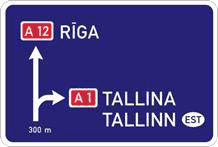 702.
702. 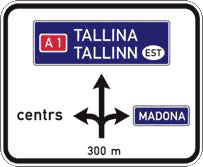
283.2. sign No. 703 "Direction sign". Directions of travel and distances (km) to built-up areas and other objects;
703. 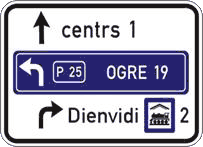
283.3. signs No. 704 and 705 "Direction sign". Direction of travel and distance (km) to a built-up area or another object;
704.  705.
705. 
283.4. sign No. 706 "Direction sign". Direction of travel and distance (km) to a tourist attraction (sign with a brown background) or direction of travel to a farmstead (sign with a grey background);
706. 
283.5. sign No. 707 "Distance sign". Distances (km) to the centres of built-up areas on the route;
707.
283.6. sign No. 708 "Name of water obstacle". The name of a river, canal, lake or similar water obstacle crossed by the road;
708. 
283.7. sign No. 709 "Route diagram". A driving route where certain manoeuvres are prohibited at a junction or where the permitted directions of travel at a complex junction are shown;
709. 
283.8. sign No. 710 "Direction for bypassing an obstacle";
710. 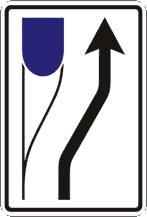
283.9. sign No. 711 "Dead end". A road through which it is not possible to drive through;
711. 
283.10. signs No. 712 and 713 "Advance direction sign for a dead end";
712.  713.
713. 
283.11. signs No. 714 and 715 "Start of lane". The beginning of a deceleration lane, climbing lane or similar lane;
714.  715.
715. 
283.12. signs No. 716 and 717 "End of lane". The end of an acceleration lane, climbing lane or similar lane;
716.  717.
717. 
283.13. signs No. 718, 719 and 720 "Directions of travel by lanes". The number of lanes in each direction on a road section and the directions of travel in each lane;
718. 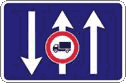 719.
719. 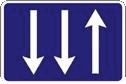 720.
720. 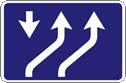
283.14. signs No. 721 and 722 "Lane joining the main lanes". One or more lanes joining the main lanes near road overpasses;
721. 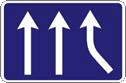 722.
722. 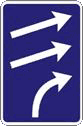
283.15. sign No. 723 "U-turn place". On a road section between junctions, indicates a place or an opening in the central reserve where making a U-turn is permitted. Turning left is prohibited;
723. 
283.16. sign No. 724 "Traffic restrictions in Latvia". Informs vehicle drivers entering Latvia about general speed limits and the use of daytime running lights or dipped-beam headlights;
724. 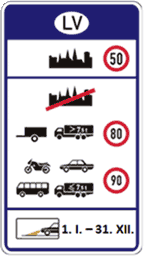
283.17. sign No. 725 "Recommended speed". The speed at which it is recommended to drive on the following road section. The sign is in force until the nearest junction after the sign, but, if sign No. 725 is used together with a warning sign, its area of effect is determined by the length of the dangerous section;
725.
283.18. signs No. 726, 727 and 728 "Direction of travel for goods vehicles". The recommended direction of travel for goods vehicles, their combinations and tractor machinery if, at a junction, they are prohibited from travelling in one of the possible directions;
726. 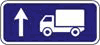 727.
727.  728.
728. 
283.19. sign No. 729 "Pedestrian underpass or overpass";
729. 
283.20. sign No. 730 "Diversion route diagram". The diversion route for a road section temporarily closed to road traffic;
730. 
283.21. signs No. 731, 732 and 733 "Direction of diversion route". Direction of diversion for a road section where road traffic is temporarily closed or restricted;
731.  732.
732.  733.
733. 
283.22. sign No. 734 "End of diversion route";
734. 
283.23. signs No. 735, 736, 737 and 738 "Advance indication to change lanes". Direction for bypassing a temporarily closed carriageway section or traffic lane;
735.  736.
736. 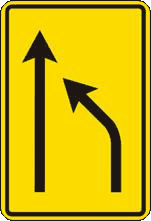 737.
737. 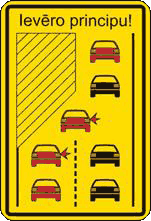 738.
738. 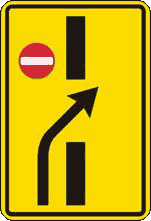
283.24. sign No. 739 "Kilometre sign". Distance (km) from the beginning of the road;
739. 
283.25. sign No. 740 "Road number". A sign with a green background and the number assigned to the relevant road (route) of the European road network;
740. 
283.26. sign No. 741 "Road number". A sign with a red background and the number assigned to the relevant Latvian main state road;
741. 
283.27. sign No. 742 "Road number". A sign with a blue background and the number assigned to the relevant Latvian regional state road;
742. 
283.28. signs No. 743, 744 and 745 "Road number and direction". The sign background indicates the class of road to which the road belongs;
743.  744.
744. 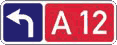 745.
745. 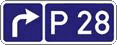
283.29. sign No. 746 "Reversible traffic". The beginning of a road section on which the direction of road traffic in one or more lanes may change to the opposite direction;
746. 
283.30. sign No. 747 "End of reversible traffic". The end of a road section on which the direction of road traffic in one or more lanes may change to the opposite direction;
747. 
283.31. sign No. 748 "Exit onto a road with reversible traffic". Exit onto a road on which the direction of road traffic in one or more lanes may change to the opposite direction;
748.
283.32. sign No. 749 "Name of country";
749. 
283.33. sign No. 750 "Name of administrative territory";
750. 
283.34. sign No. 751 "Tourist attraction area". Entry into an area where many tourist attractions are located close to one another;
751.
283.35. sign No. 752 "Emergency exit". Indicates the place in a tunnel where an emergency exit is located;
752. 
283.36. sign No. 753 "Direction to emergency exit". Indicates the direction in a tunnel in which one must proceed to reach an emergency exit, as well as the distance to it.
753. 
284. The blue background of signs No. 701, 702, 703, 704 and 705 (if the sign is installed in a built-up area) means that the indicated object is located outside the relevant built-up area, while the white background means that the indicated object is located in the relevant built-up area.
701. 702. 703. 704. 705.
284.1 Information on possible directions of travel at multi-level junctions:
284.1 1. sign No. 754 "Advance indication of an exit from an expressway". Provides information about an exit from an expressway;
754. 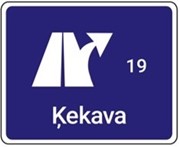
284.1 2. sign No. 755 "Exit ahead". Additional warning of approaching an exit from an expressway (distance 300 m (3 stripes), 200 m (2 stripes), 100 m (1 stripe));
755. 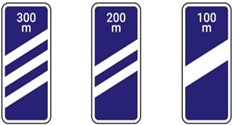
284.1 3. sign No. 756 "Direction indication". Placed at the exit above the carriageway or between carriageways.
756. 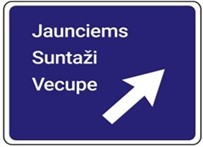
26.8. Additional Signs
285. Additional signs are used together with other signs and specify or restrict the effect of the relevant signs. Additional signs are as follows:
285.1. additional sign No. 801 "Distance to an object". Indicates the distance from the sign to the beginning of a dangerous road section or to the place where the relevant road traffic restriction is introduced;
801.
285.2. additional sign No. 802 "Distance to an object". Indicates the distance from road sign No. 206 to the junction if road sign No. 207 is installed immediately before the junction;
802. 206. 207.
285.3. additional sign No. 803 "Area of effect". Indicates the length of the dangerous road section marked with warning signs, or the area of effect of a prohibitory sign, including at a junction, as well as the area of effect of road signs Nos. 537, 539 and 725;
803. 537. 539. 725.
285.4. additional signs Nos. 804–808 "Area of effect". Indicate the direction and area of effect of road signs Nos. 326, 327, 328, 329, 537 and 539. Additional signs Nos. 804 and 808 also indicate the distance to an object marked with road sign No. 537 or No. 539, while additional signs Nos. 805–807 indicate the area of effect of road signs Nos. 537 and 539 if they are installed parallel to the edge of a parking place;
804.  805.
805.  806.
806.  807.
807.  808.
808.  326. 327. 328. 329. 537. 539.
285.5. additional sign No. 809 "Area of effect". Informs the vehicle driver that he or she is within the area of effect of road sign No. 326, 327, 328 or 329;
809.  326. 327. 328. 329.
285.6. additional sign No. 810 "Area of effect". Indicates the end of the area of effect of road signs Nos. 326, 327, 328 and 329;
810. 326. 327. 328. 329.
285.7. additional signs Nos. 811, 812 and 813 "Area of effect". Indicate the direction of effect of the main sign towards a particular part of the road;
811.  812.
812.  813.
813. 
285.8. additional sign No. 814 "Direction of effect";
814. 
285.9. additional sign No. 815 "Directions of effect";
815. 
285.10. additional sign No. 816 "Direction of effect";
816. 
285.11. additional sign No. 817 "Traffic lane". Indicates the traffic lane or tram track bed to which the effect of the sign applies. If additional sign No. 817 is installed together with a prohibitory sign, the prohibition is in force until the nearest junction beyond the sign;
817.
285.12. additional signs Nos. 818–824 "Type of vehicle". Indicate the type of vehicle to which the effect of the sign applies. Additional sign No. 818 applies to lorries, including lorries with trailers or semi-trailers, whose maximum authorised mass exceeds 3.5 t. Additional sign No. 820 applies to cars, including cars with trailers, as well as to lorries whose maximum authorised mass does not exceed 3.5 t. Additional sign No. 823 applies to mopeds, motorcycles, tricycles and quadricycles. Additional sign No. 824 applies to bicycles and electric scooters;
818.  819.
819.  820.
820.  821.
821.  822.
822.  823.
823.  824.
824.
285.13. additional sign No. 825 "On working days";
825. 
285.14. additional sign No. 826 "On Saturdays, Sundays and public holidays";
826. 
285.15. additional sign No. 827 "Time of effect". Indicates the time of day during which the sign is in effect;
827. 
285.16. additional signs Nos. 828 and 829 "Time of effect". Indicate the days and times of day during which the sign is in effect;
828.  829.
829. 
285.17. additional signs Nos. 830–839 "Type of vehicle placement in a parking place". Additional signs Nos. 832–839 indicate how cars without trailers, motorcycles, tricycles and quadricycles are to be placed in a parking place next to a footway or partly on it, while additional signs Nos. 830 and 831 also indicate how cars with trailers are to be placed in a parking place next to a footway or partly on it;
830. 831. 832. 833. 834. 835. 836. 837. 838. 839.
285.18. additional sign No. 840 "Parking time". This additional sign is used together with road signs Nos. 529 and 537. A driver who has parked a car in a parking place marked with these signs must place information in the car interior by the windscreen showing the time when the vehicle was parked;
840.  529. 537.
285.19. additional sign No. 841 "Vehicle inspection place". Indicates that an inspection ramp or inspection pit for vehicles has been provided;
841. 
285.20. additional sign No. 842 "Maximum authorised mass restriction". Indicates that the sign applies only to vehicles whose maximum authorised mass is greater than that indicated on the additional sign;
842. 
285.21. additional sign No. 843 "Blind pedestrians". Indicates that the pedestrian crossing is also used by blind pedestrians;
843. 
285.22. additional sign No. 844 "For persons with disabilities". Indicates that road sign No. 537 applies only to cars marked with a disabled parking card;
844.  537.
537.
285.23. additional sign No. 845 "Wet surface". Indicates that the sign applies during the period when the carriageway surface is wet;
845. 
285.24. additional sign No. 846 "Slippery surface". Indicates that there is a slippery road section ahead covered with snow or ice;
846. 
285.25. additional sign No. 847 "Direction of the priority road". Indicates the direction of the priority road at a junction;
847.
285.26. additional sign No. 848 "Tow-away vehicle operating". The additional sign is installed together with road signs Nos. 326, 327, 328 and 329, and also without them in places where parked vehicles hinder entry to or exit from courtyards and similar places;
848.  326. 327. 328. 329.
285.27. additional sign No. 849 "Other additional information". Indicates information not contained in the other additional signs, such as cancelling the prohibition on stopping and parking within the area of effect of road signs Nos. 326, 327, 328 and 329 for vehicles with special permits, where the driver must place a permit of the relevant content issued by the owner or manager of the parking place in the car interior by the windscreen, or indicating the period during which loading and unloading of goods is permitted, and similar information;
849.  326. 327. 328. 329.
285.28. additional sign No. 850 "Speed hump". Indicates that the pedestrian crossing is arranged on an artificial elevation intended to reduce driving speed;
850. 
285.29. additional sign No. 851 "Paid parking operating time". Indicates that a parking place marked with road sign No. 529 or No. 537 is used as a paid parking place for a specified period, while at other times it is free of charge;
851.  529. 537.
285.30. additional sign No. 852 "Switch off engine". Indicates that parking with the engine running is prohibited in the parking place;
852.
285.31. additional sign No. 853 "Control device". Indicates that a stationary device for controlling or recording road users or vehicles may be installed;
853. 
285.32. additional sign No. 854 "Information about a bicycle path". Indicates that bicycle and electric scooter traffic is organised in the indicated directions on the road being crossed or on a part of it;
854. 
285.33. additional sign No. 855 "Information about a bicycle path". The sign indicates that on a road marked with road sign No. 501, bicycle and electric scooter traffic is organised on a marked part of the road opposite to the direction of travel of other vehicles. The arrows indicate one-way or two-way traffic;
855.  501.
501.
285.34. additional sign No. 856 "Information about a bicycle path". The sign indicates to bicycle and electric scooter riders the traffic organisation procedure when bicycle and electric scooter traffic is organised on bicycle paths, pedestrian and bicycle paths or shared pedestrian and bicycle paths on both sides of the road. Driving in the direction crossed out with a red cross is prohibited;
856. 
285.35. additional sign No. 857 "Bicycle route". The sign indicates the further direction of the bicycle route;
857. 
285.36. additional sign No. 858 "EuroVelo route". The sign indicates the further direction of the bicycle route;
858. 
285.37. additional sign No. 859 "Goods delivery". The sign indicates a parking place intended for regular and organised delivery of goods.
859. 
285.38. additional sign No. 860 "Electric vehicles". Indicates that charging is available in the parking place marked with road sign No. 537 and that parking is permitted only for electric vehicles and externally rechargeable hybrid vehicles while they are being charged.
860.  537.
537.
286. Additional signs Nos. 814, 815 and 816 indicate the directions of effect of signs installed before a junction or the direction of travel to a parking place marked with road sign No. 537 or 539 and located in the immediate vicinity of the road.
814. 815. 816. 537. 539.
287. Additional signs Nos. 825 and 826 indicate the days on which the sign is in effect.
825. 826.
288. Additional signs are attached directly below the sign to which they apply, except for additional sign No. 848 or No. 853 if it is installed without a main sign. If the signs are placed above the carriageway, shoulder or footway, additional signs Nos. 809, 810 and 847 may be attached next to the sign.
848. 853. 809. 810. 847.
27. Road Markings
289. Road markings (Annex 5) must comply with the requirements of standards LVS 85:2016 "Road markings", LVS 85:2016/A1:2018 "Road markings" and LVS 93:2006 "Road delineator posts. Rules of use". Pedestrian crossings are designed in accordance with standard LVS 190-10:2007 "Pedestrian crossing design rules", LVS 190-10:2007/A1:2010 "Pedestrian crossing design rules" and LVS 190-10:2007/A2:2020 "Pedestrian crossing design rules".
290. Vertical markings on road structures, equipment elements and at roadworks sites indicate the dimensions of an object and also serve as orientation aids. Vertical markings are as follows:
290.1. road markings Nos. 901, 902, 903 and 904 indicate the direction of travel in bends where visibility is restricted by buildings, greenery and similar objects, the direction of travel at three-way junctions and the direction for bypassing roadworks sites;
901.  902.
902.  903.
903.  904.
904. 
290.2. road marking No. 905 marks elevations that must be bypassed on the right or on the left, such as central reserves, safety islands and similar objects;
905. 
290.3. road markings Nos. 906 and 907 mark elevations to be bypassed on the left (road marking No. 906) and on the right (road marking No. 907), such as central reserves, safety islands and similar objects, as well as obstacles, such as the ends of barriers and fences and similar objects, which are located in the immediate vicinity of the carriageway and may be dangerous to moving vehicles;
906.  907.
907. 
290.4. road markings Nos. 908, 909, 910, 911, 912 and 913 mark roadworks and road traffic accident sites (road markings Nos. 908 and 910 – roadworks sites to be bypassed on the left; road markings Nos. 909 and 911 – roadworks sites to be bypassed on the right; road marking No. 912 – further driving prohibited; road marking No. 913 – roadworks and road traffic accident sites);
908.  909.
909.  910.
910.  911.
911.  912.
912.  913.
913. 
290.5. road markings Nos. 914 and 915 mark elements of road structures, such as bridge or overpass supports and similar objects, which may be dangerous to moving vehicles and which must be bypassed on the left (road marking No. 914) or on the right (road marking No. 915);
914.  915.
915. 
290.6. road marking No. 916 marks the lower edge of the span structures of tunnels, bridges and overpasses;
916. 
290.7. road markings Nos. 917 and 918 mark delineator posts (road marking No. 917 – on the right side of the road; road marking No. 918 – on the left side of the road);
917.  918.
918. 
290.8. road marking No. 919 delineates the carriageway.
919. 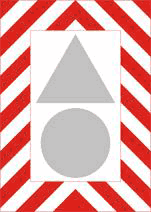
291. To draw attention to dangerous road sections, such as places where vehicles enter the road from an adjacent territory and similar places, the marking of road markings Nos. 917 and 918 — the delineator post marking — may be yellow on a black background.
917. 918.
292. Horizontal road markings (lines, arrows, symbols and other markings on the road) determine specific traffic regimes and procedures. Horizontal road markings are white, except for road markings Nos. 943, 944, 945, 946, 947 and 948, which are yellow. Horizontal road markings are as follows:
943. 944. 945. 946.  947. 948.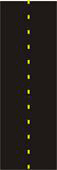
292.1. road marking No. 920 – a solid line – separates streams of vehicles travelling in opposite directions, marks traffic lane boundaries in dangerous places, sections of the carriageway into which entry is prohibited, the boundaries of vehicle parking places and parking areas, the edge of the carriageway on road sections where stopping and parking are prohibited, and also separates a lane intended for the movement of certain vehicles. A wide line separates a cycle lane from the carriageway for other motor vehicles in places where a cycle lane is arranged on the road at the same level as its surface;
920.
292.2. road marking No. 921 – a double solid line – separates streams of vehicles travelling in opposite directions on roads with three or more traffic lanes, except for acceleration or deceleration lanes;
921.
292.3. road marking No. 922 – a broken line with strokes three times shorter than the gaps between them – separates streams of vehicles travelling in opposite directions on roads with two traffic lanes, except for acceleration or deceleration lanes, and also marks traffic lane boundaries on roads with two or more traffic lanes in one direction;
922. 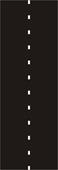
292.4. road marking No. 923 – a broken line with strokes three times longer than the gaps between them – separates streams of vehicles travelling in the opposite or the same direction and warns of approaching the line of road marking No. 920, 921 or 928;
923.  920. 921. 928.
292.5. road marking No. 924 – a broken line with strokes twice as long as the gaps between them – marks the edge of the carriageway on road sections where stopping and parking are allowed;
924.
292.6. road marking No. 925 – a broken line with strokes equal in length to the gaps between them – marks lane or cycle lane boundaries within a junction, or cycle lane places where other vehicles are allowed to cross it;
925.
292.7. road marking No. 926 – a wide broken line – marks the boundary between an acceleration lane and a main lane, between a deceleration lane and a main lane, or between a passenger public transport stop and a main lane;
926. 
292. Horizontal road markings (lines, arrows, symbols and other markings on the road) determine specific traffic regimes and procedures. Horizontal road markings are white, except for road markings Nos. 943, 944, 945, 946, 947 and 948, which are yellow. Horizontal road markings are as follows:
927.
292.9. road marking No. 928 – a solid line together with road marking No. 923 – separates streams of vehicles travelling in the opposite direction on uphill or downhill road sections, separates streams of vehicles travelling in the same direction on roads with several traffic lanes in one direction, and also marks places intended for making a U-turn, entering or leaving parking places and similar. These road marking lines may be crossed only from the side of the broken line. If the marking separates streams of vehicles travelling in opposite directions, it may be crossed from the side of the solid line in order to return to one’s own side of the direction of travel;
928. 923.
292.10. road marking No. 929 – a wide solid transverse line, the stop line – indicates the place before which the driver must stop the vehicle if road sign No. 207 is installed or if driving is prohibited by a traffic light signal or a traffic controller’s signal;
929. 207.
292.11. road marking No. 930 – a wide broken transverse line with strokes twice as long as the gaps between them – indicates the place where the driver must, if necessary, stop the vehicle in order to give way to vehicles or other road users;
930. 
292.12. road marking No. 931 – several wide parallel longitudinal lines separated from one another – marks a pedestrian crossing;
931.
292.13. road marking No. 932 – two wide broken transverse lines separated from one another – marks the place where the carriageway or pedestrian path is crossed by a bicycle path, by the part of a pedestrian and bicycle path intended for bicycles and electric scooters, or by a shared pedestrian and bicycle path;
932.
292.14. road marking No. 933 – two chequered transverse lines separated from one another – marks the boundaries of an artificial elevation on the carriageway, a speed hump intended to reduce driving speed;
933.
292.15. road markings Nos. 934, 935 and 936 mark direction islands at places where vehicle streams split or merge, as well as the beginning and end of central reserves and safety islands. Driving onto these road markings is prohibited;
934.  935.
935.  936.
936. 
292.16. road marking No. 937 indicates the permitted directions of travel. It is used independently or together with road sign No. 513, 514, 515, 516, 517 or 518. A marking which permits a left turn also permits a U-turn from the leftmost traffic lane;
937.  513. 514. 515. 516. 517. 518.
292.17. road marking No. 938 warns of approaching a narrowing of the carriageway, namely a place where the number of traffic lanes in the direction of travel decreases. It may be used independently or together with road sign No. 107, 108, 109, 716 or 717;
938.  107. 108. 109. 716. 717.
292.18. road marking No. 939 warns of approaching the line of road marking No. 920 or 928, which separates streams of vehicles travelling in opposite directions;
939. 920. 928.
292.19. road marking No. 940 marks a traffic lane intended for passenger public transport vehicles and taxis;
940.
292.20. road marking No. 941 marks a bicycle path, the part of a pedestrian and bicycle path intended for bicycles and electric scooters, or a cycle lane;
941.
292.21. road marking No. 942 marks a parking place intended for vehicles marked with a disabled parking card;
942. 
292.22. road marking No. 943 – a solid yellow line on the edge or kerb of the carriageway – marks road sections where stopping and parking of vehicles are prohibited. It is used independently or together with road sign No. 326;
943. 326.
292.23. road marking No. 944 – a broken yellow line on the edge or kerb of the carriageway – marks a road section where parking of vehicles is prohibited. It is used independently or together with road sign No. 327;
944. 327.
292.24. road marking No. 945 marks places where parking of vehicles is prohibited;
945.
292.25. road marking No. 946 marks the area of a passenger public transport stop or taxi parking place;
946.
292.26. road marking No. 947 – a solid yellow line – is a temporary road marking at roadworks and similar places. It separates streams of vehicles travelling in opposite directions, marks traffic lane boundaries if there are at least two traffic lanes in one direction, marks sections of the carriageway, such as direction islands and safety islands, into which entry is prohibited, and also marks carriageway edges where stopping and parking of vehicles are prohibited. Crossing this road marking line is prohibited;
947.
292.27. road marking No. 948 – a broken yellow line – is a temporary road marking at roadworks and similar places. It marks traffic lane boundaries if there are at least two traffic lanes in one direction;
948.
292.28. road marking No. 949 warns of approaching road marking No. 930;
949.  930.
930.
292.29. road marking No. 950 marks a place in a tunnel intended for placing a vehicle in the event of a forced stop;

292.30. road marking No. 951 warns of approaching road marking No. 929;
951.  929.
929.
292.31. road marking No. 952 indicates a maximum speed limit;
952. 
292.32. road marking No. 953 indicates a road number;
953. 
292.33. road marking No. 954 indicates an airport or airfield;
954. 
292.34. road marking No. 955 marks a pedestrian path or the part of a pedestrian and bicycle path intended for pedestrians.
955. 
292.35. road marking No. 956 marks a part of the carriageway intended for bicycles and electric scooters, but on which other vehicles are also allowed to travel;
956.
292.36. road marking No. 957 marks a parking place where charging is available and parking is permitted only for electric vehicles and externally rechargeable hybrid vehicles while they are being charged;
957. 
292.37. road marking No. 958 draws the vehicle driver’s attention to compliance with the permitted driving speed;
958. 
292.38. road marking No. 959 marks a place where vehicles are prohibited from entering if congestion has formed beyond it which may force the vehicle driver to stop the vehicle on it, except where stopping the vehicle is necessary in order to turn right, turn left or make a U-turn and to give way to road users who have priority.
959. 
293. A vehicle driver must comply with the requirements established by road markings Nos. 947 or 948 even if those requirements conflict with the requirements of other horizontal road markings.
947. 948.
294. If, while driving in a lane marked with road marking No. 927, the vehicle driver no longer has in front of him or her the traffic light referred to in Paragraph 48 of these Regulations, or if it is switched off, the driver must immediately change lanes to the right.
927.
295. It is prohibited to cross road marking lines Nos. 920 and 921, except for road marking line No. 920 if it is used to mark the boundaries of a parking place, or if it separates streams of vehicles travelling in opposite directions in order to return to one’s own side of the direction of travel, as well as in the cases referred to in Paragraph 110 of these Regulations.
920. 921.
296. If temporary signs placed, for example, on a portable stand, on a vehicle carrying out roadworks or in another way indicating the temporary nature of the installation of those signs have a different meaning from road marking lines, the vehicle driver must comply with the requirements of the temporary signs.